
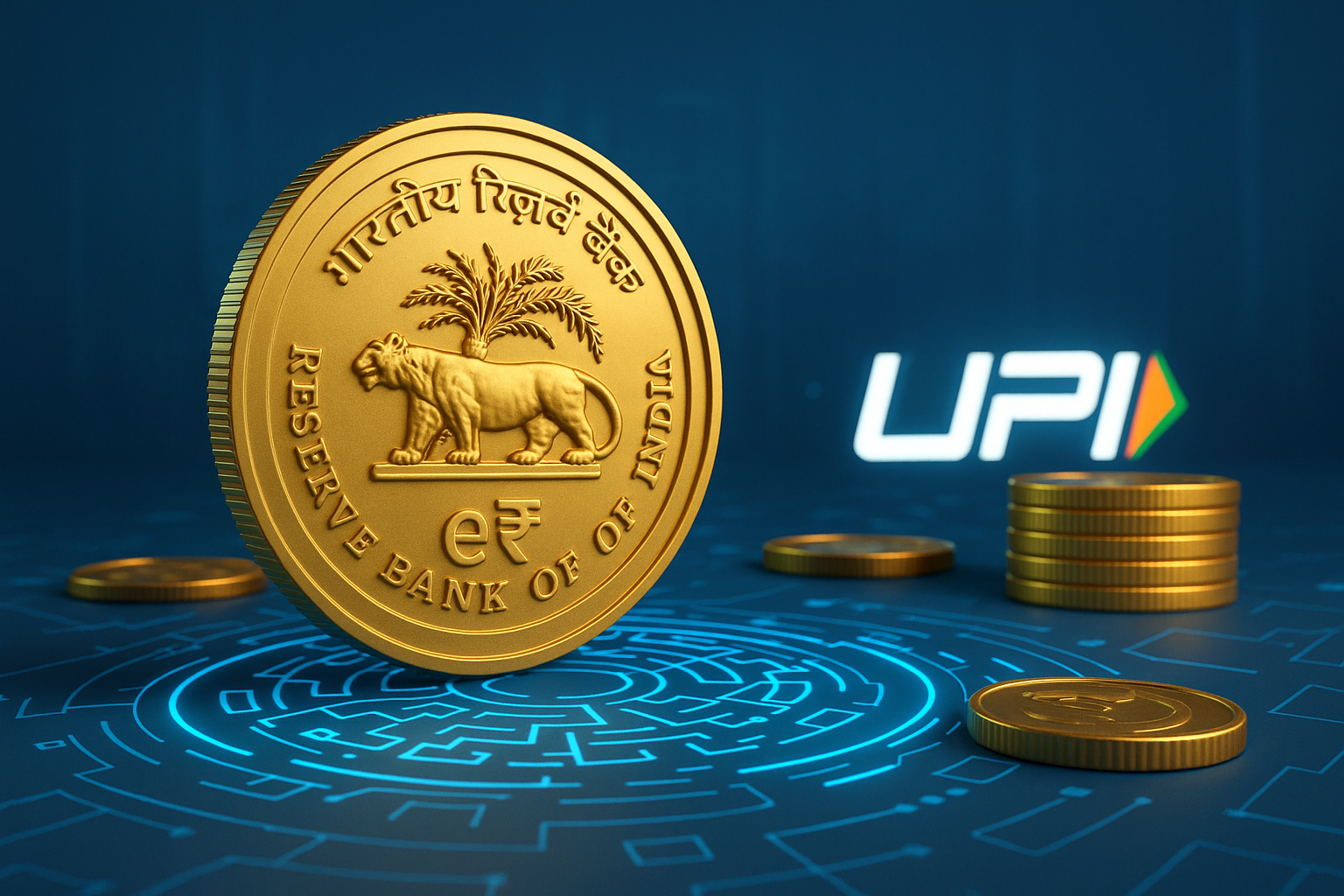
The Reserve Bank of India (RBI) is scaling up its efforts to promote Central Bank Digital Currency (CBDC) in the country. According to its Annual Report 2024–25, the central bank plans to introduce new features and expand the scope of both retail and wholesale digital rupee pilots.
New Features: Programmability & Offline Payments
To boost adoption, the RBI is testing programmability, allowing digital rupee usage for specific, pre-defined purposes such as government subsidies or corporate spending limits.
The central bank is also experimenting with offline payments, making the CBDC accessible in rural and low-connectivity regions.
“Offline capability can be a game-changer in remote areas,” said an RBI official in the report.
Retail CBDC Expands Reach
The retail CBDC pilot now includes 17 banks and has onboarded over 600,000 users. In a significant move, the RBI has allowed select non-banks to offer digital rupee wallets, potentially enabling fintech companies to participate in CBDC services.
Wholesale CBDC Gains Institutional Traction
The wholesale CBDC pilot, focused on interbank transactions, has been expanded to include four standalone primary dealers (SPDs), increasing its scope and testing depth.
This could make India’s interbank settlement system faster and more efficient using blockchain-based solutions.
UPI Dominates Global Real-Time Payments
India continues to lead the world in real-time digital payments, driven by the Unified Payments Interface (UPI). In FY 2024–25:
- Digital payment volume grew by 34.8%
- UPI contributed to 48.5% of global real-time payments
A new “Delegated Payments” feature was introduced, letting primary users authorize others to make payments from their accounts within set limits — expanding financial inclusion.
Supreme Court Demands Crypto Regulation
On May 20, 2025, India’s Supreme Court urged the government to regulate cryptocurrencies, calling the lack of a framework a threat to the financial system.
“A parallel economy is dangerous,” said Justice Surya Kant.
Despite a 30% tax on crypto profits, over 100 million Indians are estimated to hold digital assets.
Conclusion
The RBI’s push for a programmable, inclusive, and offline-friendly digital rupee marks a major leap in India’s financial digitization journey. Combined with UPI’s global dominance, the country is fast becoming a leader in fintech innovation.