
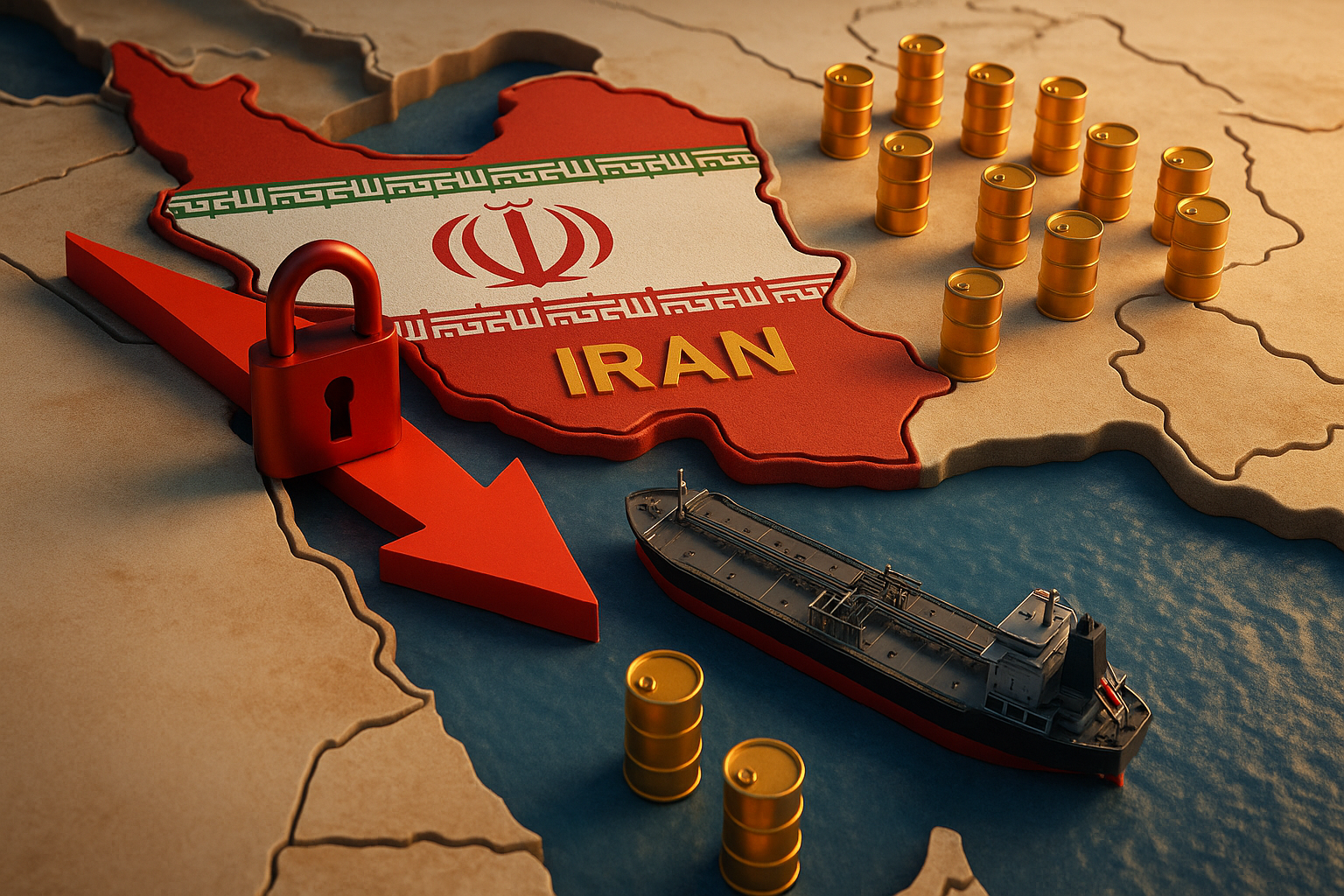
Tensions in the Middle East escalated sharply as Iran threatened to close the Strait of Hormuz, a critical maritime passageway responsible for nearly 20% of the world’s oil supply and 30% of global LNG shipments. The move comes amid intensifying missile exchanges with Israel and growing fears that the conflict is now targeting both physical and financial infrastructure.


Strait of Hormuz: A Global Energy Lifeline

The Strait of Hormuz is a narrow chokepoint that separates the Persian Gulf from the Gulf of Oman. It is one of the most strategically vital shipping lanes globally. Any disruption to its operation could trigger severe consequences for the global energy market.

Nearly 21 million barrels of oil per day pass through this waterway — roughly 1 in every 5 barrels consumed worldwide.
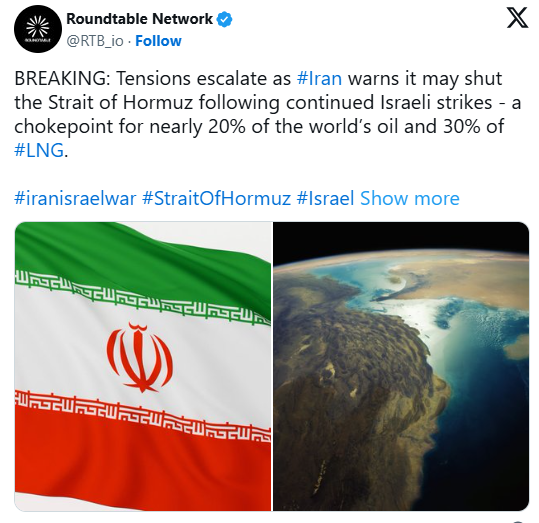
Following Iran’s threat, Brent crude oil has jumped from $70 per barrel to over $77, a sharp 10% increase since June 13, when the conflict reignited. Analysts warn that prices could spike beyond $90 per barrel if a full-scale blockade occurs.


Crypto Markets React With Caution

The broader cryptocurrency market has not remained immune to the geopolitical uncertainty.

  • The total crypto market cap has slipped 3%, falling to $3.25 trillion since June 13.
  • Bitcoin (BTC) dropped over 3%, currently trading near $104,826.78.
  • Ethereum (ETH) posted a steeper decline, down approximately 9% to $2,532.18.

This decline underscores the risk-off sentiment dominating global markets as traders seek safety in cash, gold, and other stable assets.


Financial Systems Under Cyber Threat

In parallel with the physical escalation, cyberattacks on financial platforms are intensifying. Banks, stock exchanges, and crypto platforms have all come under siege, adding another layer of instability.

The convergence of warfare and financial infrastructure disruption signals a dangerous new era where traditional markets and decentralized systems alike are vulnerable.


Global Outlook: Markets on Edge

While oil markets are pricing in potential supply shocks, equity and digital asset traders are recalibrating positions based on geopolitical headlines. The threat of Hormuz’s closure is not only about oil — it’s a barometer for how quickly regional conflict can become a global economic event.

With the U.S. and European powers monitoring the situation closely, the next few days could be critical for both energy security and financial stability.


Conclusion: Risk and Volatility Ahead

The situation in the Middle East is moving fast. If the Strait of Hormuz is closed, it could jolt oil markets, pressure inflation globally, and send shockwaves across both traditional and crypto financial systems. Traders should stay informed, manage risk carefully, and expect heightened volatility.

Disclaimer

This content is for informational purposes only and does not constitute financial, investment, or legal advice. Cryptocurrency trading involves risk and may result in financial loss.

logo

blockto.io

info@blockto.io

Blockto.io Copyright © 2025, All rights reserved

News
Rates
Buy
More
We use cookies to personalize content and ads, provide social media features, and analyze our traffic. In accordance with GDPR/AVG and EU cookie regulations, data is processed only with your consent. We may share information about your use of our website with our social media, advertising, and analytics partners, and you can manage or withdraw your consent at any time. View more
Cookies settings
Accept
Privacy & Cookie policy
Privacy & Cookies policy
Cookie name Active

Privacy Policy

At BitxJournal.com, we respect your privacy and are committed to protecting your personal data. This Privacy Policy explains how we collect, process, store, and protect personal information in accordance with the General Data Protection Regulation (GDPR) and AVG (EU privacy legislation).

1. Data Controller

BitxJournal.com acts as the data controller for all personal data processed through this website.

2. Personal Data We Collect

We may collect and process the following categories of data:

Personal Data

  • Name and email address (when you subscribe to newsletters or contact us)

Technical & Usage Data

  • IP address, browser type, operating system

  • Device information

  • Pages visited, referral sources, and interaction data

This data is collected via cookies, log files, and analytics technologies.

3. Legal Basis for Processing

We process personal data only when a lawful basis exists, including:

  • Consent – when you explicitly agree (e.g., cookies, newsletter sign-up)

  • Legitimate interest – to operate, secure, and improve our website

  • Legal obligation – when required by applicable laws

You may withdraw your consent at any time.

4. Purpose of Data Processing

Your data is processed for the following purposes:

  • Operating and maintaining the website

  • Improving content, usability, and performance

  • Sending newsletters or updates (only with consent)

  • Analyzing traffic and user behavior

  • Responding to inquiries or support requests

5. Cookies & Consent Management

We use cookies and similar technologies in compliance with EU Cookie Law.

  • Non-essential cookies are placed only after explicit user consent

  • Users may accept, reject, or manage cookie preferences at any time

  • Consent can be withdrawn without affecting prior lawful processing

Detailed cookie information is available in our Cookie Settings panel.

6. Third-Party Data Processing

We may share limited data with trusted third-party service providers, including:

  • Analytics providers (e.g., Google Analytics)

  • Advertising partners (for personalized or non-personalized ads)

These third parties act as data processors and process data only under contractual obligations compliant with GDPR/AVG.

7. International Data Transfers

Where data is transferred outside the European Economic Area (EEA), we ensure appropriate safeguards are in place, such as Standard Contractual Clauses (SCCs) or equivalent legal mechanisms.

8. Data Retention

We retain personal data only for as long as necessary to fulfill the purposes outlined in this policy or as required by law.

9. Data Security

We implement appropriate technical and organizational security measures to protect personal data against unauthorized access, alteration, disclosure, or destruction.

10. Your GDPR Rights

Under GDPR/AVG, you have the right to:

  • Access your personal data

  • Rectify inaccurate or incomplete data

  • Request data erasure (“right to be forgotten”)

  • Restrict or object to processing

  • Data portability

  • Withdraw consent at any time

  • Lodge a complaint with a supervisory authority

11. Changes to This Privacy Policy

We reserve the right to update this Privacy Policy at any time. Any changes will be posted on this page with a revised effective date.

12. Contact Information

For privacy-related inquiries or GDPR requests, contact:

📧 Email: support@blockto.io
🌐 Website: https://blockto.io

Save settings
Cookies settings