

The Bank for International Settlements (BIS) has issued a strong critique of stablecoins, arguing they are fundamentally flawed as monetary instruments and pose significant risks to global financial systems. In its Annual Economic Report 2025, the BIS stated that stablecoins fail to meet essential benchmarks of modern money—singleness, elasticity, and integrity—and warned of their potential for misuse in financial crimes.


Why Stablecoins Fail to Qualify as Real Money

The BIS defined “singleness” as the uniform acceptability of money at face value. Unlike central bank money, stablecoins are often issued by private entities and may trade at different values depending on platforms or markets. This disrupts the principle of parity, creating fragmentation rather than consistency in monetary exchange.

“Stablecoins perform poorly when assessed against the three tests for serving as the mainstay of the monetary system,” the report emphasized.


Elasticity and Liquidity: Another Shortcoming

The second pillar, “elasticity,” refers to a system’s ability to adapt to liquidity demands during economic shocks. The BIS criticized stablecoins for operating on a “cash-in-advance” basis, where supply is strictly limited to prior funding.

This model lacks the flexibility of traditional banking systems, where central banks can inject liquidity as needed to stabilize financial markets.


Integrity Risks: Crime, Laundering, and Sanctions

The most serious concern outlined was the lack of integrity in stablecoin ecosystems, especially those transacted via unhosted wallets and public blockchains. According to the BIS, these mechanisms make stablecoins vulnerable to:

  • Money laundering
  • Sanctions evasion
  • Terrorist financing

“Stablecoins have significant shortcomings when it comes to promoting the integrity of the monetary system,” the report warned.
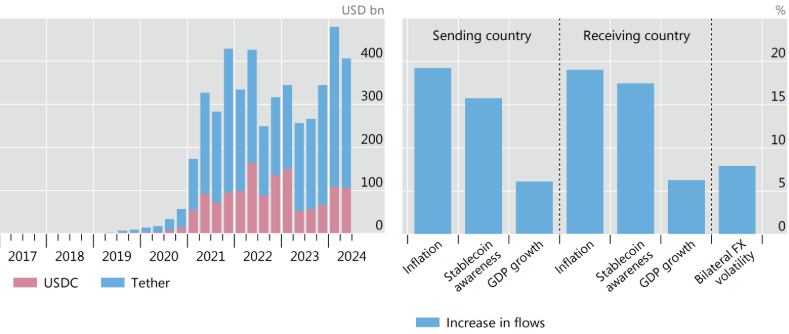

Stablecoins May Have a Limited, Regulated Role

Despite its criticism, the BIS did acknowledge the growing demand for stablecoins, especially in cross-border payments and low-cost transfers. However, it advocated for tight regulation and limited use, stressing that these digital assets should not replace sovereign currencies.

The report further stated:
“Society can re-learn the historical lessons about the limitations of unsound money.”


Tokenization Praised as a Financial Innovation

In contrast to its stance on stablecoins, the BIS described tokenization—the digital representation of real-world assets—as a “transformative innovation.” Unlike stablecoins, tokenized assets are seen as complementary to existing systems rather than disruptive.


Market Reaction and Industry Response

Following the BIS publication, USDC issuer Circle’s stock dropped over 15%, reflecting market concerns about regulatory clampdowns. Industry analysts argued the BIS’s position was unsurprising, given its alignment with central banks.

Disclaimer

This content is for informational purposes only and does not constitute financial, investment, or legal advice. Cryptocurrency trading involves risk and may result in financial loss.

    logo

    blockto.io

    info@blockto.io

    Blockto.io Copyright © 2025, All rights reserved

    News
    Rates
    Buy
    More
    We use cookies to personalize content and ads, provide social media features, and analyze our traffic. In accordance with GDPR/AVG and EU cookie regulations, data is processed only with your consent. We may share information about your use of our website with our social media, advertising, and analytics partners, and you can manage or withdraw your consent at any time. View more
    Cookies settings
    Accept
    Privacy & Cookie policy
    Privacy & Cookies policy
    Cookie name Active

    Privacy Policy

    At BitxJournal.com, we respect your privacy and are committed to protecting your personal data. This Privacy Policy explains how we collect, process, store, and protect personal information in accordance with the General Data Protection Regulation (GDPR) and AVG (EU privacy legislation).

    1. Data Controller

    BitxJournal.com acts as the data controller for all personal data processed through this website.

    2. Personal Data We Collect

    We may collect and process the following categories of data:

    Personal Data

    • Name and email address (when you subscribe to newsletters or contact us)

    Technical & Usage Data

    • IP address, browser type, operating system

    • Device information

    • Pages visited, referral sources, and interaction data

    This data is collected via cookies, log files, and analytics technologies.

    3. Legal Basis for Processing

    We process personal data only when a lawful basis exists, including:

    • Consent – when you explicitly agree (e.g., cookies, newsletter sign-up)

    • Legitimate interest – to operate, secure, and improve our website

    • Legal obligation – when required by applicable laws

    You may withdraw your consent at any time.

    4. Purpose of Data Processing

    Your data is processed for the following purposes:

    • Operating and maintaining the website

    • Improving content, usability, and performance

    • Sending newsletters or updates (only with consent)

    • Analyzing traffic and user behavior

    • Responding to inquiries or support requests

    5. Cookies & Consent Management

    We use cookies and similar technologies in compliance with EU Cookie Law.

    • Non-essential cookies are placed only after explicit user consent

    • Users may accept, reject, or manage cookie preferences at any time

    • Consent can be withdrawn without affecting prior lawful processing

    Detailed cookie information is available in our Cookie Settings panel.

    6. Third-Party Data Processing

    We may share limited data with trusted third-party service providers, including:

    • Analytics providers (e.g., Google Analytics)

    • Advertising partners (for personalized or non-personalized ads)

    These third parties act as data processors and process data only under contractual obligations compliant with GDPR/AVG.

    7. International Data Transfers

    Where data is transferred outside the European Economic Area (EEA), we ensure appropriate safeguards are in place, such as Standard Contractual Clauses (SCCs) or equivalent legal mechanisms.

    8. Data Retention

    We retain personal data only for as long as necessary to fulfill the purposes outlined in this policy or as required by law.

    9. Data Security

    We implement appropriate technical and organizational security measures to protect personal data against unauthorized access, alteration, disclosure, or destruction.

    10. Your GDPR Rights

    Under GDPR/AVG, you have the right to:

    • Access your personal data

    • Rectify inaccurate or incomplete data

    • Request data erasure (“right to be forgotten”)

    • Restrict or object to processing

    • Data portability

    • Withdraw consent at any time

    • Lodge a complaint with a supervisory authority

    11. Changes to This Privacy Policy

    We reserve the right to update this Privacy Policy at any time. Any changes will be posted on this page with a revised effective date.

    12. Contact Information

    For privacy-related inquiries or GDPR requests, contact:

    📧 Email: support@blockto.io
    🌐 Website: https://blockto.io

    Save settings
    Cookies settings