

In a landmark decision that may reshape future NFT copyright disputes, the US Ninth Circuit Court of Appeals has overturned a $9 million judgment in favor of Yuga Labs in its ongoing legal battle against digital artist Ryder Ripps and business partner Jeremy Cahen.
Yuga Labs’ Trademark Claims Sent Back for Trial
The appeals court ruled that Yuga Labs failed to prove its key argument — that Ripps and Cahen’s NFT project was “likely to cause consumer confusion” with the Bored Ape Yacht Club (BAYC) brand. The judges unanimously agreed that the case requires a federal trial to determine whether the contested NFT collection infringes upon Yuga’s trademarks.
This ruling reverses a prior federal decision from 2023 which awarded Yuga Labs $1.6 million in damages — later raised to $9 million — based on claims of trademark infringement and cybersquatting.
The case now heads back to a California district court, where both sides will present further arguments.
Ripps NFT Collection Deemed Not Fair Use
While the court reversed the monetary award, it also denied Ripps’ defense of fair use, ruling that his use of Yuga’s brand was not protected as nominative fair use or expressive artistic work under the First Amendment.
This means Ripps cannot argue that his collection was purely satire or commentary — a major legal blow to his case, even as the $9 million judgment is vacated.
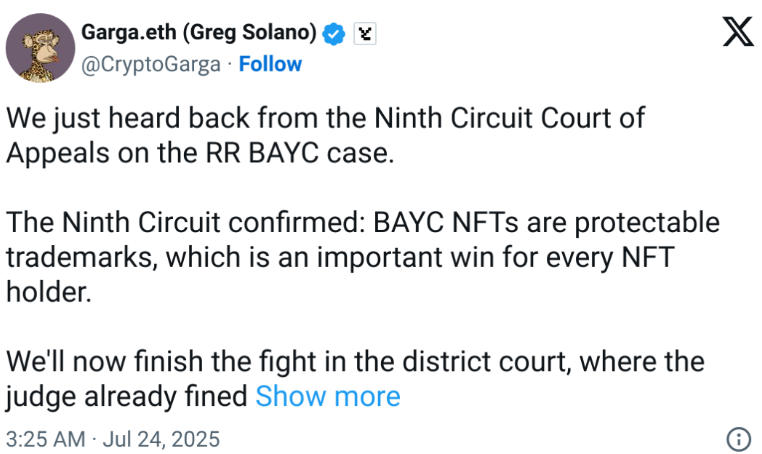
NFTs Recognized as Trademark-Protected Goods
Despite the reversal, Yuga Labs secured a partial legal win. The court affirmed that NFTs qualify as “goods” under US trademark law, potentially setting a legal precedent for future intellectual property cases involving NFTs.
This classification gives NFT creators more grounds to enforce their trademarks, especially against lookalike or derivative collections.
What This Means for NFT Creators and Artists
The case highlights growing legal tension between artistic expression and intellectual property in Web3. On one hand, the ruling supports free expression by denying automatic infringement claims. On the other, it reinforces that NFT brands can be legally protected trademarks.
As the case returns to trial, the NFT community and digital creators alike will closely watch the outcome — one that could redefine how NFT ownership, brand identity, and copyright interact under U.S. law.
Disclaimer
This content is for informational purposes only and does not constitute financial, investment, or legal advice. Cryptocurrency trading involves risk and may result in financial loss.