
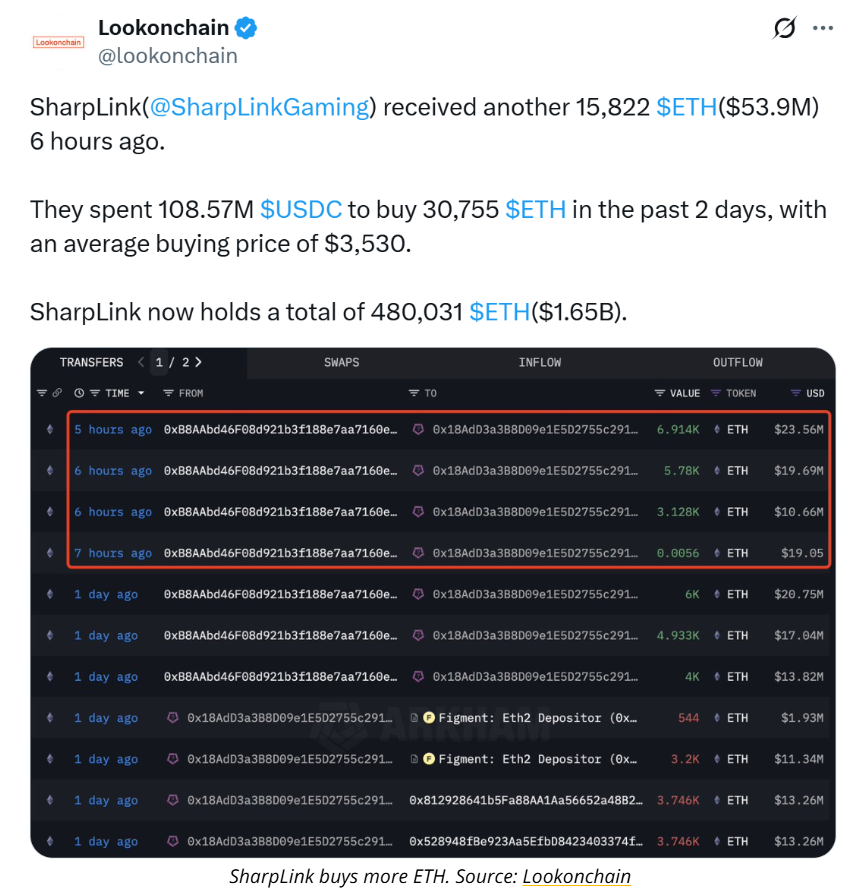
Ethereum (ETH) continues to attract institutional money, with SharpLink adding another $54 million in Ether to its treasury. The move raises the company’s total ETH holdings to 480,031 ETH, now worth approximately $1.65 billion, based on on-chain data from Arkham Intelligence.
$108.57M in 48 Hours: SharpLink’s ETH Accumulation Spree
Over the past 48 hours, SharpLink aggressively acquired 30,755 ETH, spending over $108 million in USDC at an average price of $3,530. The largest single transaction included 6,914 ETH, valued at $23.56 million.
This rapid accumulation positions SharpLink as one of the largest corporate holders of Ether.
The firm’s latest tranche of 15,822 ETH, valued at $53.9 million, comes just days after a $43.09 million purchase of 11,259 ETH at an average price of $3,828.
Ether Machine Joins the ETH Race
Meanwhile, The Ether Machine, another corporate whale, purchased 15,000 ETH worth $56.9 million, bringing its holdings to 334,757 ETH. That surpasses the Ethereum Foundation’s 234,000 ETH, making it the third-largest corporate ETH holder behind BitMine and SharpLink.
The company, which formed via a merger with Nasdaq-listed Dynamix Corp, is targeting a $1.6B raise and plans to go public under the ticker ETHM later in 2025.
Corporate Treasuries Bet on Ethereum
More corporations are adopting Ethereum as a reserve asset, not only for price exposure but also for its utility. According to NoOnes CEO Ray Youssef, Ethereum’s value lies in its staking yield, programmability, and growing regulatory alignment.
Ethereum currently hosts 58.1% of the $13.4B real-world asset (RWA) market, including tokenized assets and stablecoins.
With its role in tokenized finance expanding, Ethereum is quickly becoming the preferred reserve currency among forward-looking enterprises.
Final Take
With SharpLink and Ether Machine making multi-million-dollar bets on ETH, it’s clear that Ethereum is no longer just a protocol — it’s becoming enterprise-grade digital infrastructure. As corporate ETH holdings grow, expect increased price sensitivity, institutional governance pressure, and greater demand for staking and L2 utility.
Disclaimer
This content is for informational purposes only and does not constitute financial, investment, or legal advice. Cryptocurrency trading involves risk and may result in financial loss.