
Analysts Point to Undervaluation and Strong Technical Signals
Chainlink’s native token, LINK, surged to $26.05 after an 18% rally, significantly outpacing other top 50 cryptocurrencies. Analysts are now highlighting undervaluation, strong technical indicators, and upcoming product developments in August as key drivers behind the move.
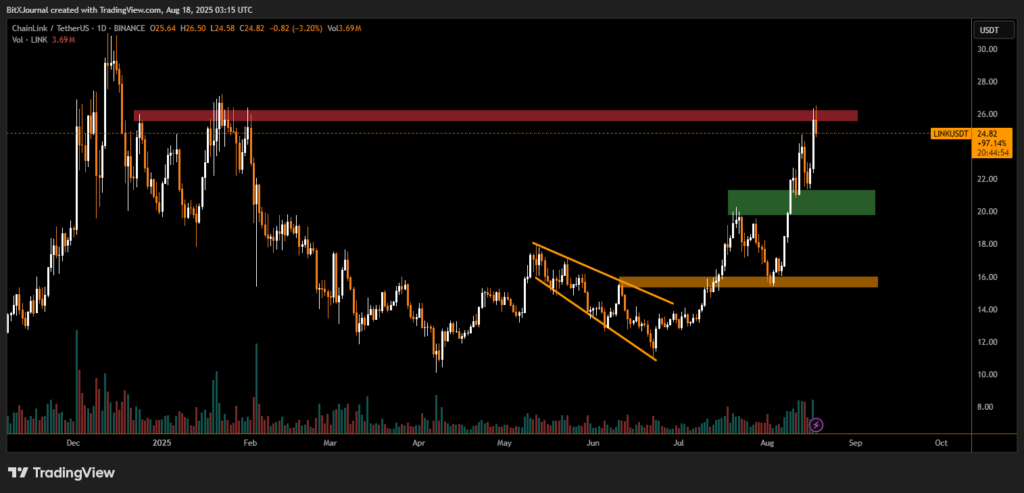
On the daily chart, LINK has broken out of a prolonged descending channel, with prices moving sharply higher from the $15 support area. A strong accumulation zone formed between $15–$16, followed by a breakout through the $20 resistance, which is now acting as support.
The latest rally pushed LINK into the $25–$26 supply zone, a region that previously rejected price advances. Traders are now watching whether LINK can consolidate above this level to confirm the breakout.
“Chainlink has been showing one of the cleanest technical structures in the market,”According to BITX market analyst. “The breakout from the falling wedge pattern and the reclaim of major support levels highlight renewed bullish momentum.”
Despite the nearly 100% surge from July lows, analysts argue LINK remains very undervalued compared to its long-term fundamentals. Chainlink continues to expand its ecosystem, with recent August announcements focusing on Cross-Chain Interoperability Protocol (CCIP) adoption and decentralized oracle solutions.
“Chainlink’s technology underpins much of the DeFi space, yet its market valuation doesn’t fully reflect the scale of its integration,” According to BITX. “This gap creates room for further price appreciation if adoption accelerates.”
With trading volumes spiking above 3.6 million LINK on Binance, momentum remains strong. If LINK maintains support above $20, analysts suggest the next key level to watch lies near $30, while failure to hold current gains could see a retest of the $20 demand zone.
Disclaimer
This content is for informational purposes only and does not constitute financial, investment, or legal advice. Cryptocurrency trading involves risk and may result in financial loss.