

Fidelity report suggests growing long-term holdings could tighten market liquidity
Bitcoin’s circulating supply could see a significant squeeze in the coming decade, with over 42% projected to become illiquid by 2032, according to a new analysis by Fidelity.
Long-term holders and corporate treasuries driving supply lock-up
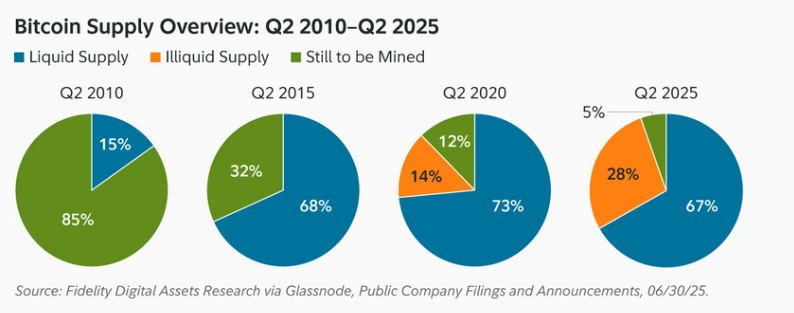
The report identifies two main cohorts responsible for this shift: long-term Bitcoin holders — defined as those who have not moved their coins in at least seven years — and publicly traded companies with treasury holdings exceeding 1,000 BTC. Both groups have steadily accumulated and retained their assets, with little evidence of supply reduction over the past several years.
Fidelity estimates that these groups will hold over six million BTC by 2025, accounting for nearly 28% of the total 21 million Bitcoin supply cap. Currently, more than 969,000 BTC are held by 105 publicly traded companies, representing 4.61% of total supply.
Illiquid supply may influence Bitcoin price dynamics
The projected supply squeeze could have major implications for market pricing. “We estimate that nearly 42% — or over 8.3 million Bitcoin — will be considered illiquid by Q2 2032,” the report stated.
By reducing the amount of Bitcoin available on exchanges, illiquid supply increases scarcity, a factor often linked to upward price pressure. Historically, long-term holders have shown resilience, with their aggregate supply remaining stable since 2016.
Potential risks of whale sell-offs
Despite the bullish supply outlook, Fidelity also highlighted potential risks. As of Q2 2025, the combined holdings of these groups were valued at $628 billion, with an average entry price of $107,700 per BTC. Large liquidations by whales could trigger sharp corrections. Recent data shows whales sold $12.7 billion worth of BTC in the past 30 days, the largest sell-off since 2022, contributing to a modest 2% price decline.
Looking ahead, the tightening of circulating supply may support Bitcoin’s long-term value proposition, particularly if institutional adoption continues to grow. However, the market remains sensitive to sudden sell-offs from large holders, highlighting the balance between scarcity-driven price growth and volatility risks.
Disclaimer
This content is for informational purposes only and does not constitute financial, investment, or legal advice. Cryptocurrency trading involves risk and may result in financial loss.