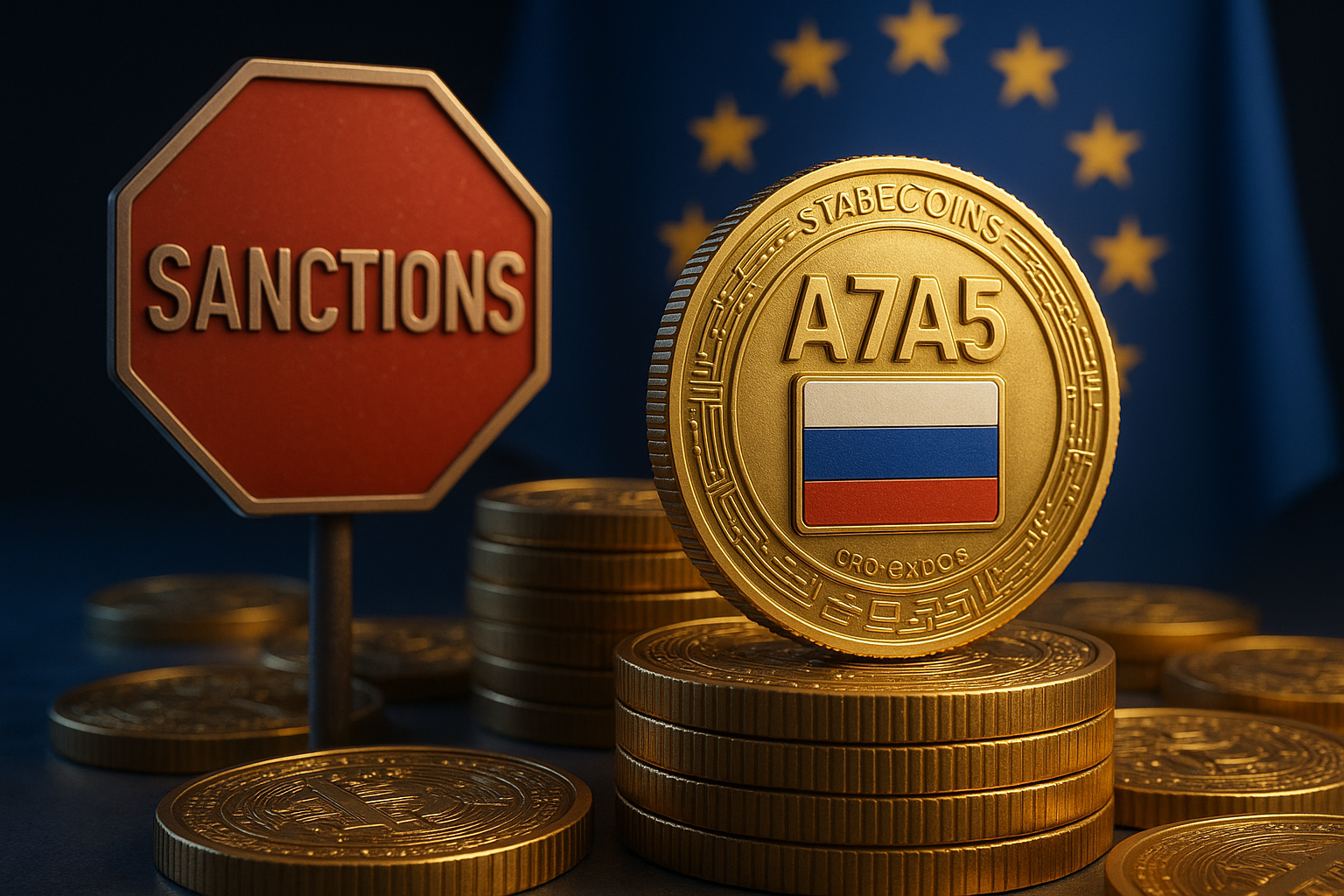
October 23, 2025 — The European Union has adopted its 19th sanctions package against Russia, introducing sweeping new restrictions targeting cryptocurrency platforms and the A7A5 ruble-backed stablecoin amid growing concerns that Moscow is using digital assets to evade financial sanctions.
Announced Thursday, the measures ban Russia-based crypto payment providers and prohibit the distribution of related payment software across the EU. The sanctions also expand to include Russian energy companies, banks, and intermediaries in China, Kyrgyzstan, Tajikistan, Hong Kong, and the UAE, which the EU accuses of assisting Moscow in circumventing existing restrictions.
“We have just adopted our 19th package of sanctions,” said Kaja Kallas, the EU’s High Representative for Foreign Affairs and Security Policy. “It targets Russian energy, banks, crypto exchanges, and entities in China, among others.”
We just adopted our 19th sanctions package.
It targets Russian banks, crypto exchanges, entities in India and China, among others.
The EU is curbing Russian diplomats’ movements to counter the attempts of destabilisation.
It is increasingly harder for Putin to fund this war.
The A7A5 ruble-backed stablecoin was identified by EU authorities as a “prominent tool for financing activities supporting the war of aggression.” The new rules ban all issuance and trading of A7A5 within the bloc and sanction its Kyrgyz issuer along with an unnamed digital asset platform where “significant volumes” of A7A5 were traded.
Nineteenth package of sanctions against Russia
At least eight banks and oil traders from Central Asia, Hong Kong, and the UAE are also being sanctioned for helping Russia move funds via cryptocurrencies and stablecoins.
Russia’s Growing Reliance on Crypto
The European Council noted that Russia’s use of digital assets to bypass restrictions has intensified in 2025. Reports indicate that Russian oil companies have used Bitcoin (BTC) and Tether (USDT) to facilitate tens of millions of dollars in monthly transactions outside the traditional financial system.
In March, Reuters reported that several sanctioned Russian firms were increasingly turning to crypto to settle cross-border energy trades. In July, two Russian nationals residing in New York were charged with laundering over $540 million through crypto platforms, highlighting global efforts to curb sanction evasion.
The inclusion of crypto-related entities in the EU’s latest sanctions marks a major policy shift, signaling Brussels’ intent to close digital loopholes that have enabled Russian firms to sustain financial operations.
Disclaimer
This content is for informational purposes only and does not constitute financial, investment, or legal advice. Cryptocurrency trading involves risk and may result in financial loss.
We use cookies to personalize content and ads, provide social media features, and analyze our traffic. In accordance with GDPR/AVG and EU cookie regulations, data is processed only with your consent. We may share information about your use of our website with our social media, advertising, and analytics partners, and you can manage or withdraw your consent at any time. View more
Cookies settings
Accept
Privacy & Cookie policy
Privacy & Cookies policy
Cookies list
Cookie name
Active
Privacy Policy
At BitxJournal.com, we respect your privacy and are committed to protecting your personal data. This Privacy Policy explains how we collect, process, store, and protect personal information in accordance with the General Data Protection Regulation (GDPR) and AVG (EU privacy legislation).
1. Data Controller
BitxJournal.com acts as the data controller for all personal data processed through this website.
2. Personal Data We Collect
We may collect and process the following categories of data:
Personal Data
Name and email address (when you subscribe to newsletters or contact us)
Technical & Usage Data
IP address, browser type, operating system
Device information
Pages visited, referral sources, and interaction data
This data is collected via cookies, log files, and analytics technologies.
3. Legal Basis for Processing
We process personal data only when a lawful basis exists, including:
Consent – when you explicitly agree (e.g., cookies, newsletter sign-up)
Legitimate interest – to operate, secure, and improve our website
Legal obligation – when required by applicable laws
You may withdraw your consent at any time.
4. Purpose of Data Processing
Your data is processed for the following purposes:
Operating and maintaining the website
Improving content, usability, and performance
Sending newsletters or updates (only with consent)
Analyzing traffic and user behavior
Responding to inquiries or support requests
5. Cookies & Consent Management
We use cookies and similar technologies in compliance with EU Cookie Law.
Non-essential cookies are placed only after explicit user consent
Users may accept, reject, or manage cookie preferences at any time
Consent can be withdrawn without affecting prior lawful processing
Detailed cookie information is available in our Cookie Settings panel.
6. Third-Party Data Processing
We may share limited data with trusted third-party service providers, including:
Analytics providers (e.g., Google Analytics)
Advertising partners (for personalized or non-personalized ads)
These third parties act as data processors and process data only under contractual obligations compliant with GDPR/AVG.
7. International Data Transfers
Where data is transferred outside the European Economic Area (EEA), we ensure appropriate safeguards are in place, such as Standard Contractual Clauses (SCCs) or equivalent legal mechanisms.
8. Data Retention
We retain personal data only for as long as necessary to fulfill the purposes outlined in this policy or as required by law.
9. Data Security
We implement appropriate technical and organizational security measures to protect personal data against unauthorized access, alteration, disclosure, or destruction.
10. Your GDPR Rights
Under GDPR/AVG, you have the right to:
Access your personal data
Rectify inaccurate or incomplete data
Request data erasure (“right to be forgotten”)
Restrict or object to processing
Data portability
Withdraw consent at any time
Lodge a complaint with a supervisory authority
11. Changes to This Privacy Policy
We reserve the right to update this Privacy Policy at any time. Any changes will be posted on this page with a revised effective date.
12. Contact Information
For privacy-related inquiries or GDPR requests, contact: