
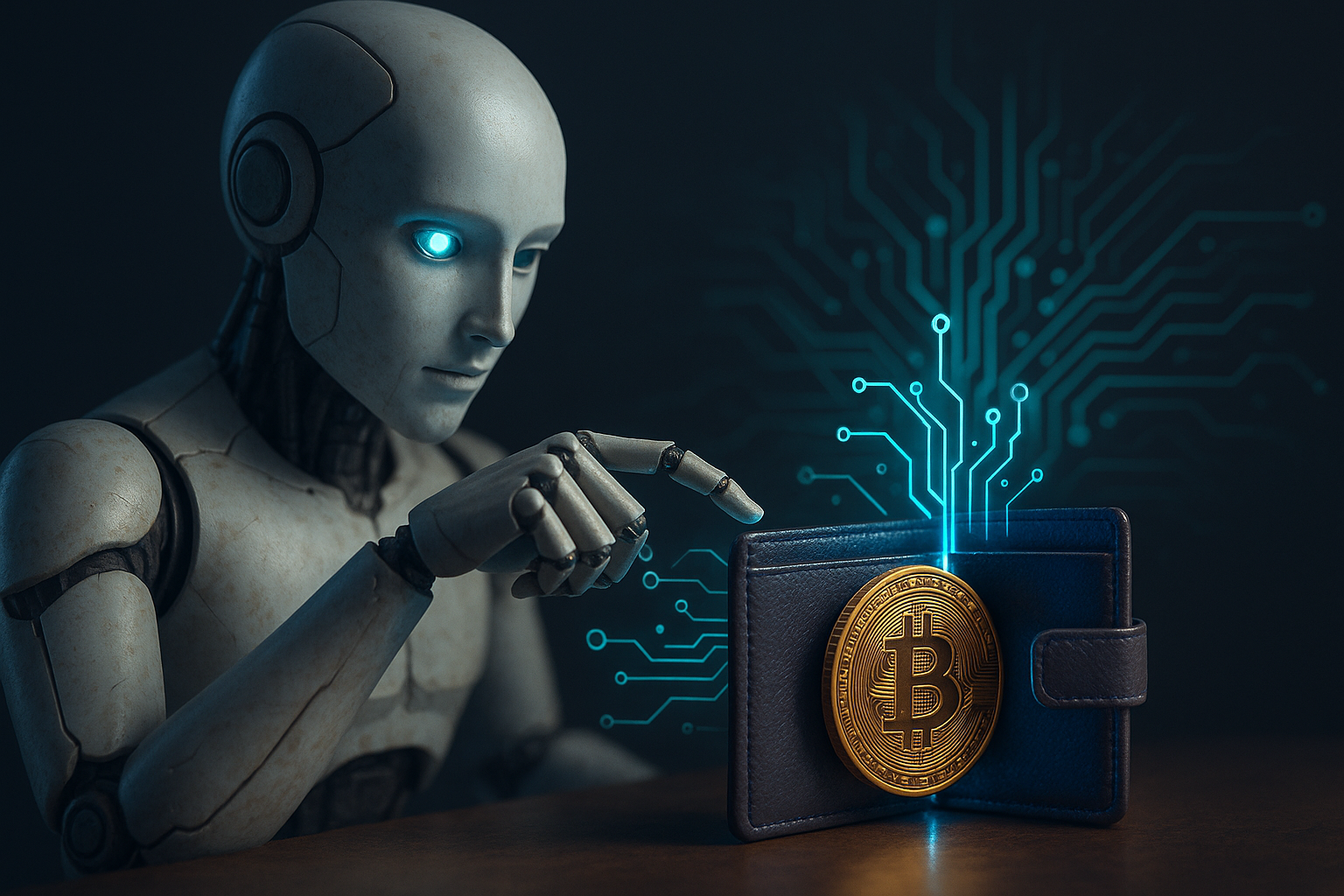
Experts weigh in on the risks and rewards of letting artificial intelligence manage digital assets
The next frontier of crypto innovation may not come from traders or institutions — but from AI agents capable of managing crypto wallets and executing blockchain transactions autonomously. While the concept is exciting, experts warn that it comes with new layers of risk that could redefine wallet security and user responsibility.
Last week, Coinbase announced its new tool called Payments MCP, a system designed to give AI agents access to on-chain financial tools — the same ones human users rely on for trading, payments, and data retrieval.
When paired with large language models (LLMs) such as Claude, Gemini, or Codex, the AI agent can access wallets, send stablecoin payments, tip creators, and retrieve paywalled data via the x402 protocol, a Coinbase-built payment network for instant blockchain transactions.
“It marks a new phase of agentic commerce where AI agents can act in the global economy,” the Coinbase Developer Platform stated.
AI in crypto: Safe or self-destructive?
Aaron Ratcliff, attribution lead at blockchain intelligence firm Merkle Science, told Cointelegraph that trusting AI with a crypto wallet introduces a paradox — placing human trust in a system designed to eliminate it.
“It can be safe if the system’s built correctly,” Ratcliff said. “But safety ultimately depends on the user — how they prompt the AI, how it interprets blockchain data, and how securely credentials are stored.”
He warned that credential leaks, AI hallucinations, or misinterpreted commands could result in catastrophic losses. “If trading credentials leak, the damage writes itself,” he added.
AI brings new attack surfaces
According to a CoinGecko survey of 2,632 crypto users, 87% said they would let AI agents manage at least a tenth of their portfolio. But with convenience comes vulnerability.
Ratcliff noted that malicious actors could exploit prompt injections, man-in-the-middle attacks, or fake tokens to drain funds. He also cautioned that an AI might “miss honeypots, rug-pulls, or handle slippage so poorly it burns users’ funds.”
“I’d want proof that the AI can catch front-running, spot scam tokens, audit contracts in real time, and sandbox prompts before it trades,” he said.
He further highlighted compliance risks, suggesting that without proper safeguards, AI could unintentionally send funds to sanctioned addresses or unregulated exchanges.
Coinbase’s defense: Controlled autonomy
Sean Ren, co-founder of Sahara AI, explained that Coinbase’s approach uses Model Context Protocols (MCP) — a technical safeguard that “acts as a gatekeeper between the AI and the wallet.”
“The agent can only perform approved actions — like checking balances or preparing a payment — but can’t move funds freely,” Ren said. “Even if someone tries to trick it through a prompt injection, it can’t complete a transaction on its own.”
Still, Ren warned that “safer doesn’t mean foolproof.” Users must continue to review and sign transactions manually and monitor their AI’s actions closely.
“You can’t assume the agent’s doing the right thing automatically,” he added.
AI agents are still in their infancy
Brian Huang, CEO of Glider, an AI-driven crypto portfolio platform, said that while AI can automate basic tasks like sending, swapping, and lending, the space is still in its early developmental stage.
“You’re not asking ChatGPT to Venmo your friends,” Huang joked. “These actions are simple but take longer with agents.”
However, he believes the real potential lies in portfolio rebalancing, yield optimization, and personalized financial advice.
“The customization AI can provide — the number of variables it can consider — is far beyond what any human can manage,” Huang said.
AI agents managing crypto wallets could redefine how users interact with decentralized finance — making trading faster, smarter, and more intuitive. But as experts agree, autonomy must come with accountability.
Until AI systems can guarantee data integrity, prevent injection attacks, and respect compliance boundaries, users will still need to keep a human hand on the wheel.
In crypto, convenience without caution is just another form of risk.
Disclaimer
This content is for informational purposes only and does not constitute financial, investment, or legal advice. Cryptocurrency trading involves risk and may result in financial loss.