
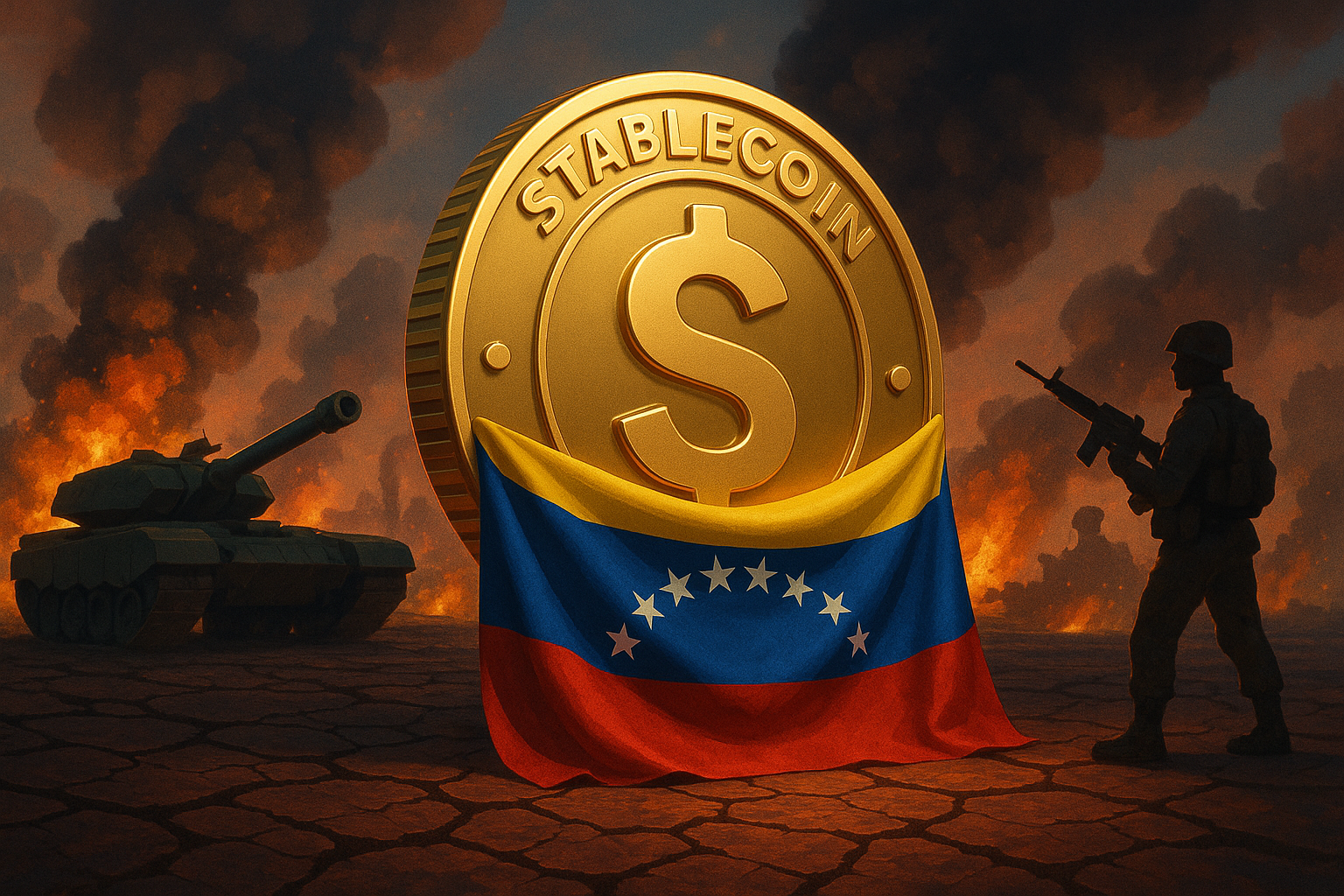
Growing economic instability pushes citizens and the government deeper into crypto adoption
Stablecoins Become Venezuela’s Economic Lifeline
Venezuela’s reliance on U.S. dollar–pegged stablecoins is intensifying as the country faces renewed geopolitical tension, hyperinflation, and international sanctions. The trend could accelerate further after the United States deployed a major aircraft carrier to the Caribbean, signaling potential military action against Venezuelan drug cartels.
President Donald Trump has accused the Venezuelan government of enabling drug smuggling into the U.S., a charge that President Nicolás Maduro has dismissed as an excuse for foreign intervention. As uncertainty mounts, ordinary Venezuelans are increasingly using stablecoins such as Tether (USDT) to preserve their savings from the rapid devaluation of the bolívar.
Locals commonly refer to stablecoins as “Binance dollars,” using them for everyday transactions and remittances as cash-based U.S. dollar circulation declines. This shift underscores how crypto has become an informal financial backbone for a nation grappling with triple-digit inflation and tight monetary restrictions.
Government and Businesses Turn to Crypto
The Venezuelan government itself has leaned on stablecoins to conduct oil trade with allies like Russia, deepening its reliance on digital assets to bypass sanctions. Reports indicate that up to half of Venezuela’s hard currency inflows now come in stablecoins, allowing state entities to move funds outside traditional banking channels.
Analysts note that this strategy has effectively “rewired Venezuela’s economy to stablecoins,” making it one of the first nations to integrate crypto into public finance on a large scale. The New York Times reported that stablecoins now play a crucial role in maintaining liquidity across both government and private sectors, amid restricted access to the global financial system.
Crypto Adoption Soars Despite Sanctions
According to Chainalysis, Venezuela ranks as the fourth-largest crypto economy in Latin America, with $44.6 billion in transaction value between July 2024 and June 2025 — trailing only Brazil, Argentina, and Mexico. This reflects not only speculative interest but also a survival-driven adoption among citizens and businesses.
Former presidential candidate Maria Corina Machado, who recently received the Nobel Peace Prize for her democratic activism, reportedly uses Bitcoin (BTC) to safeguard her assets from government seizure — a move that highlights crypto’s role as a financial refuge in authoritarian conditions.
With more than 8 million Venezuelans displaced since 2013 due to inflation, food shortages, and political turmoil, crypto has become a critical tool for cross-border value transfer and wealth preservation.
Experts warn that if military conflict or new sanctions escalate, Venezuela’s dependence on stablecoins could deepen further, potentially cementing its position as a global case study in crypto-driven economic resilience — but also exposing it to new layers of financial and political risk.
Disclaimer
This content is for informational purposes only and does not constitute financial, investment, or legal advice. Cryptocurrency trading involves risk and may result in financial loss.