
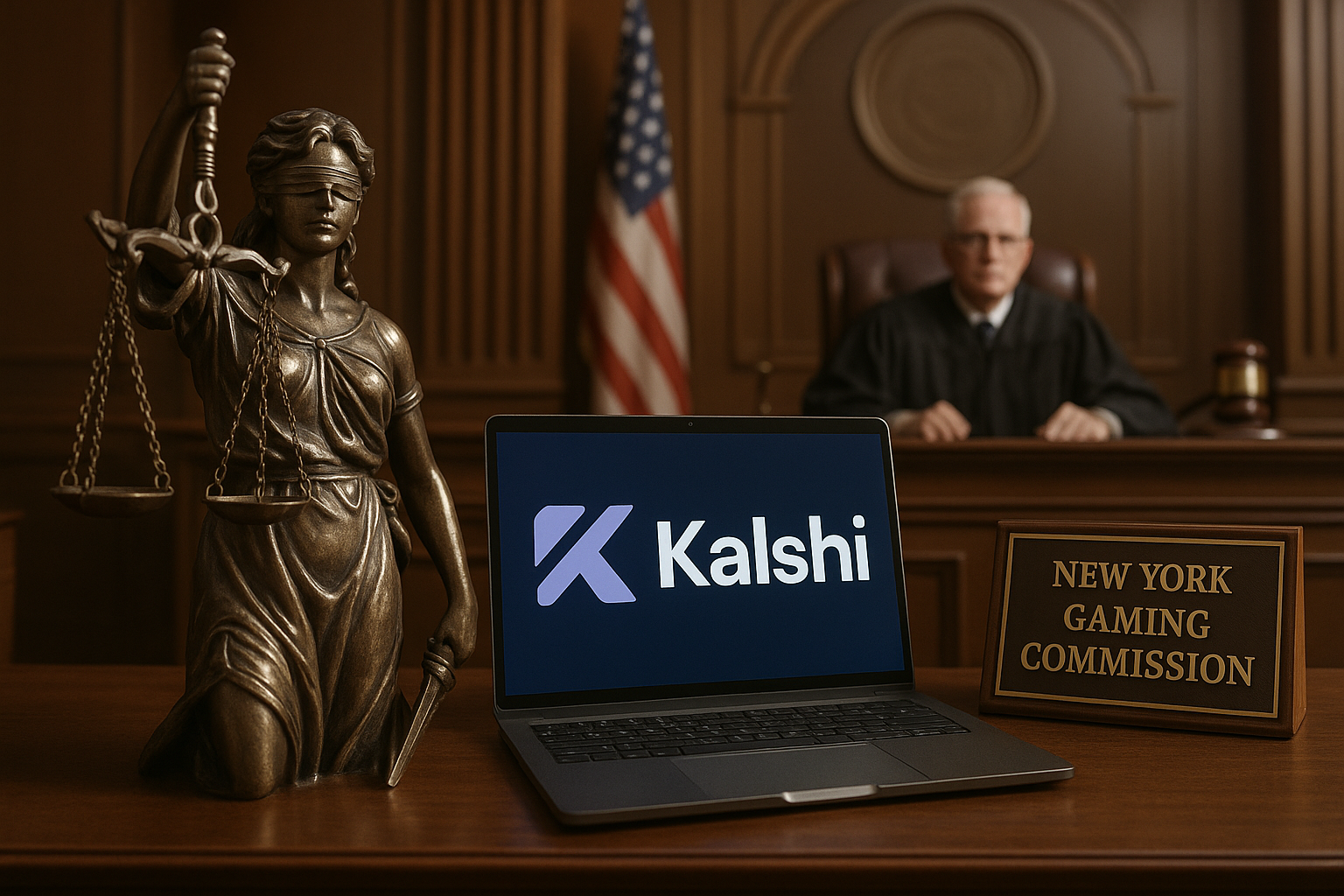
Prediction market says state has no authority over federally regulated derivatives exchange
Kalshi Challenges New York’s Cease-and-Desist Order
Prediction platform Kalshi has filed a lawsuit against the New York State Gaming Commission, claiming the regulator overstepped its authority by issuing a cease-and-desist order that accused the company of operating an unlicensed sports betting platform. The complaint, filed Monday in Manhattan federal court, asserts that Kalshi falls under the exclusive jurisdiction of the Commodity Futures Trading Commission (CFTC) — not state-level gambling regulators.
Kalshi argued that New York’s attempt to regulate its event contracts violates the U.S. Constitution’s Supremacy Clause, which grants federal law precedence over state regulation in this area. The company is seeking a preliminary and permanent injunction to block the state from enforcing the order, along with a declaration that New York cannot regulate its federally designated exchange.
Event Contracts and the Crypto Connection
Platforms like Kalshi and its blockchain-based competitor Polymarket have surged in popularity as event contracts—a form of trading where users can speculate on real-world outcomes in areas like sports, politics, and business—gain traction in both traditional and crypto markets.
However, state gambling regulators have increasingly targeted these platforms, arguing that event contracts closely resemble unlicensed betting. Kalshi, in its filing, said New York’s move “intrudes upon the federal regulatory framework that Congress established for derivatives.” The company emphasized that it is “subject to the CFTC’s exclusive jurisdiction”, making the state’s actions “field-preempted and conflict-preempted.”
Legal Battles Across Multiple States
The clash with New York is the latest in a series of legal confrontations between Kalshi and U.S. state regulators. The firm has filed similar lawsuits in Nevada, New Jersey, Maryland, and Ohio, asserting federal protection over its operations.
Kalshi has already secured preliminary injunctions in Nevada and New Jersey, with courts finding that the company would likely suffer “irreparable harm” if state enforcement actions continued. In contrast, a Maryland federal judge denied Kalshi’s request for an injunction in August, and similar rulings have been issued in related cases involving Crypto.com and Robinhood Markets.
Potential Industry Implications
Kalshi contends that New York’s enforcement efforts could threaten its viability, as shutting down event contracts in the state would require “complex technological changes whose feasibility is untested.”
Legal analysts say the case could set a significant precedent for the future of prediction markets and blockchain-based event trading platforms. If federal courts uphold Kalshi’s argument, it could reinforce CFTC authority and limit state-level oversight — a key issue as crypto-linked derivatives continue to blur the boundaries between finance and wagering.
Underlining the broader implications, Kalshi maintains that state interference poses a direct challenge to federal regulatory clarity and could stifle innovation in one of the fastest-growing segments of the digital asset market.
Disclaimer
This content is for informational purposes only and does not constitute financial, investment, or legal advice. Cryptocurrency trading involves risk and may result in financial loss.