ASIC’s Updated Framework Brings Clarity to Crypto Classification but Raises Industry Resource Questions
Australia’s corporate regulator, the Australian Securities and Investments Commission (ASIC), has released updated guidance for digital asset businesses, marking a major step toward structured crypto regulation in the country. While the move has been welcomed by the local blockchain industry, experts warn that licensing bottlenecks and limited regulatory capacity could delay implementation.
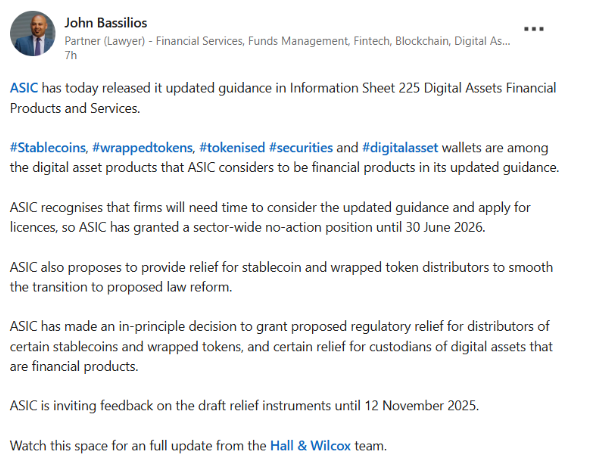
ASIC’s revised Info Sheet 225, published on Wednesday, requires crypto companies whose products fall under the financial services category to register with the Australian Financial Complaints Authority and apply for an Australian Financial Services License (AFSL) by June 30.
“It gives us visibility on ASIC’s position and how they intend to treat digital asset businesses — something we’ve long awaited,” said Amy-Rose Goodey, CEO of the Digital Economy Council of Australia.
According to the guidance, Bitcoin, gaming NFTs, and tokenized tickets are not considered financial products. This means exchanges dealing solely in Bitcoin trading won’t require a financial services license.
“If you’re an exchange and you only deal in Bitcoin, then you don’t need to apply for a license,” explained John Bassilios, partner at Hall & Wilcox.
However, stablecoins, wrapped tokens, tokenized securities, and digital asset wallets will now be treated as financial products under ASIC’s framework. This classification could also extend to yield-bearing stablecoins, tokenized real estate, and staking services involving lock-up periods or minimum balances.
ASIC noted it intends to grant regulatory relief for some stablecoin and wrapped token issuers to ease the transition toward new legislative reforms.
Implementation Challenges and Resource Constraints
Despite the clarity, industry leaders caution that structural and logistical barriers could hinder compliance.
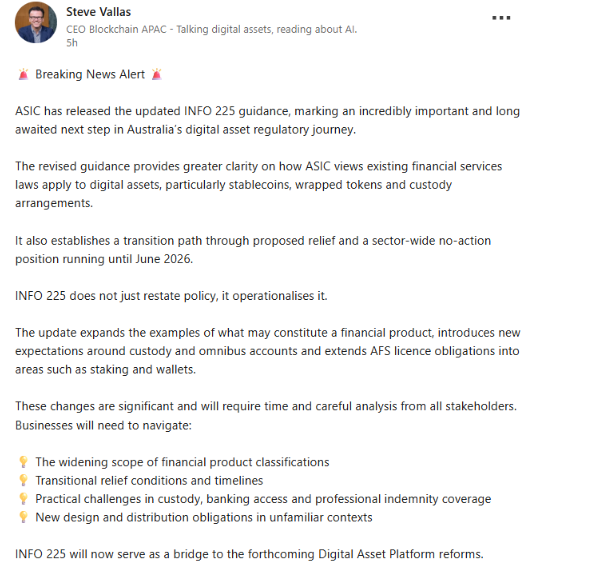
“ASIC has chosen to operationalize policy ahead of law reform,” said Steve Vallas, CEO of Blockchain APAC. “That approach brings certainty now but exposes how much interpretation is replacing actual legislation.”
Vallas warned of bottlenecks due to limited local expertise, restricted banking access, and inadequate insurance options, which could shift compliance risks from legal to operational.
The Albanese government is currently finalizing a new crypto framework under existing financial laws, following a Treasury consultation on draft regulations.
While ASIC’s move represents a crucial stride toward clarity and consumer protection, the success of Australia’s crypto regulation will ultimately depend on the regulator’s ability to manage the surge in license applications efficiently.
Disclaimer
This content is for informational purposes only and does not constitute financial, investment, or legal advice. Cryptocurrency trading involves risk and may result in financial loss.
We use cookies to personalize content and ads, provide social media features, and analyze our traffic. In accordance with GDPR/AVG and EU cookie regulations, data is processed only with your consent. We may share information about your use of our website with our social media, advertising, and analytics partners, and you can manage or withdraw your consent at any time. View more
Cookies settings
Accept
Privacy & Cookie policy
Privacy & Cookies policy
Cookies list
Cookie name
Active
Privacy Policy
At BitxJournal.com, we respect your privacy and are committed to protecting your personal data. This Privacy Policy explains how we collect, process, store, and protect personal information in accordance with the General Data Protection Regulation (GDPR) and AVG (EU privacy legislation).
1. Data Controller
BitxJournal.com acts as the data controller for all personal data processed through this website.
2. Personal Data We Collect
We may collect and process the following categories of data:
Personal Data
Name and email address (when you subscribe to newsletters or contact us)
Technical & Usage Data
IP address, browser type, operating system
Device information
Pages visited, referral sources, and interaction data
This data is collected via cookies, log files, and analytics technologies.
3. Legal Basis for Processing
We process personal data only when a lawful basis exists, including:
Consent – when you explicitly agree (e.g., cookies, newsletter sign-up)
Legitimate interest – to operate, secure, and improve our website
Legal obligation – when required by applicable laws
You may withdraw your consent at any time.
4. Purpose of Data Processing
Your data is processed for the following purposes:
Operating and maintaining the website
Improving content, usability, and performance
Sending newsletters or updates (only with consent)
Analyzing traffic and user behavior
Responding to inquiries or support requests
5. Cookies & Consent Management
We use cookies and similar technologies in compliance with EU Cookie Law.
Non-essential cookies are placed only after explicit user consent
Users may accept, reject, or manage cookie preferences at any time
Consent can be withdrawn without affecting prior lawful processing
Detailed cookie information is available in our Cookie Settings panel.
6. Third-Party Data Processing
We may share limited data with trusted third-party service providers, including:
Analytics providers (e.g., Google Analytics)
Advertising partners (for personalized or non-personalized ads)
These third parties act as data processors and process data only under contractual obligations compliant with GDPR/AVG.
7. International Data Transfers
Where data is transferred outside the European Economic Area (EEA), we ensure appropriate safeguards are in place, such as Standard Contractual Clauses (SCCs) or equivalent legal mechanisms.
8. Data Retention
We retain personal data only for as long as necessary to fulfill the purposes outlined in this policy or as required by law.
9. Data Security
We implement appropriate technical and organizational security measures to protect personal data against unauthorized access, alteration, disclosure, or destruction.
10. Your GDPR Rights
Under GDPR/AVG, you have the right to:
Access your personal data
Rectify inaccurate or incomplete data
Request data erasure (“right to be forgotten”)
Restrict or object to processing
Data portability
Withdraw consent at any time
Lodge a complaint with a supervisory authority
11. Changes to This Privacy Policy
We reserve the right to update this Privacy Policy at any time. Any changes will be posted on this page with a revised effective date.
12. Contact Information
For privacy-related inquiries or GDPR requests, contact: