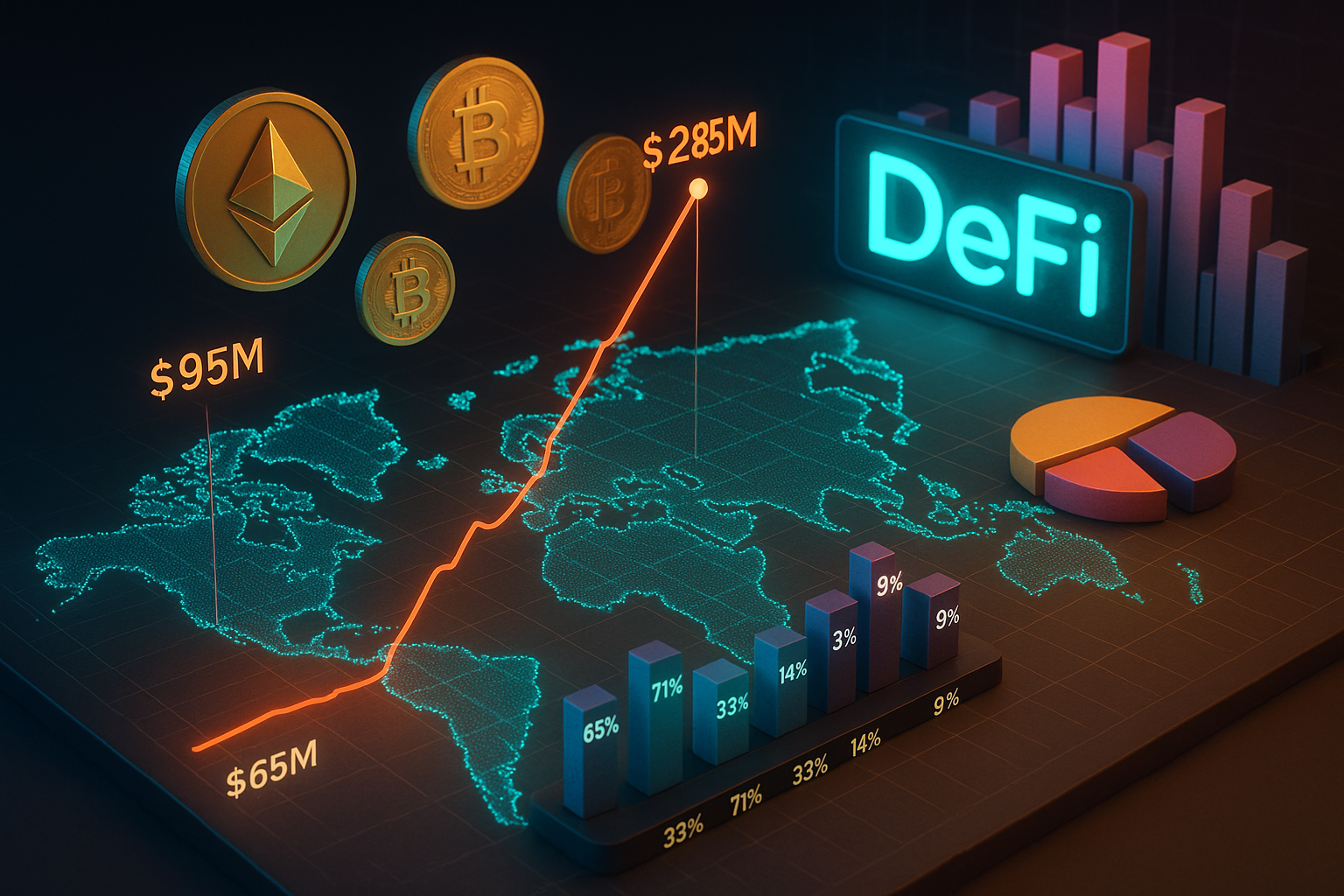
Web of interconnected loans and collateral reveals deeper systemic risks in decentralized finance
Independent analysts have traced more than $285 million in potential exposure across the decentralized finance (DeFi) ecosystem following Stream Finance’s $93 million loss, highlighting how interconnected lending markets are amplifying risk across multiple blockchains.
The breakdown, released by YieldsAndMore (YAM) — a network of DeFi researchers and onchain analysts — shows Stream’s liabilities spread across at least seven networks, implicating major counterparties such as Elixir, MEV Capital, Varlamore, TelosC, and Re7 Labs.
According to YAM’s data, Stream’s synthetic assets — xUSD, xBTC, and xETH — were rehypothecated across protocols like Euler, Morpho, Silo, and Sonic, creating a layered web of interdependencies that could magnify contagion if redemptions fail.
This is a massive loss. It's unclear how this will be settled in between xUSD/xBTC/xETH holders and lenders against these tokens, so let’s go over all stablecoins/vaults that have (in)direct exposure to Stream.
Best we can tell, these stablecoins have indirect exposure: Elixir’s… https://t.co/QEPsWf1fM2
YAM’s preliminary mapping lists TelosC ($123.6M), Elixir ($68M), and MEV Capital ($25.4M) as the largest entities linked to Stream-related lending activity. Elixir’s deUSD stablecoin reportedly lent $68 million in USDC to Stream — accounting for nearly 65% of its total reserves. Despite Elixir’s claim that it retains “full redemption rights at $1,” YAM reports that Stream’s repayments are on hold pending legal review.
Other protocols, including Treeve’s scUSD, appear entangled through multi-layered lending loops involving Mithras, Silo, and Euler, suggesting further ripple effects as positions unwind.
“This map is still incomplete,” YAM noted. “We expect more affected vaults to surface once lending contracts are fully audited.”
The Stream incident follows a turbulent week for decentralized finance, marked by the $128 million Balancer exploit and Moonwell’s $1 million oracle attack on Base and Optimism networks. Combined, these three events have wiped out over $220 million in total value, underscoring the fragility of DeFi’s interconnected liquidity systems.
We have detected multiple exploit transactions on @MoonwellDeFi lending contract.
The exploiter was able to repeatedly borrow over 20 wstETH with only ~0.02 wrstETH flashloaned and deposited due to the faulty oracle that returns wrst price of ~5.8M$ and… pic.twitter.com/130RHsUe4J
The crisis began when Stream Finance halted all deposits and withdrawals after disclosing a $93 million shortfall across its synthetic asset markets. The protocol issues tokenized assets such as xUSD, xBTC, and xETH, each backed by onchain collateral pegged to real-world assets.
Stream’s model relies heavily on overcollateralization and rehypothecation, mechanisms meant to improve capital efficiency but which can amplify systemic risk. A drop in collateral value or a failure in one lending loop can trigger cascading liquidations throughout connected protocols.
While Stream has not yet released a full post-mortem, early analysis points to collateral devaluation and liquidity mismatches between its xAssets and their onchain counterparts. It remains unclear whether user funds will be recovered or if insurance mechanisms are in place.
Disclaimer
This content is for informational purposes only and does not constitute financial, investment, or legal advice. Cryptocurrency trading involves risk and may result in financial loss.
We use cookies to personalize content and ads, provide social media features, and analyze our traffic. In accordance with GDPR/AVG and EU cookie regulations, data is processed only with your consent. We may share information about your use of our website with our social media, advertising, and analytics partners, and you can manage or withdraw your consent at any time. View more
Cookies settings
Accept
Privacy & Cookie policy
Privacy & Cookies policy
Cookies list
Cookie name
Active
Privacy Policy
At BitxJournal.com, we respect your privacy and are committed to protecting your personal data. This Privacy Policy explains how we collect, process, store, and protect personal information in accordance with the General Data Protection Regulation (GDPR) and AVG (EU privacy legislation).
1. Data Controller
BitxJournal.com acts as the data controller for all personal data processed through this website.
2. Personal Data We Collect
We may collect and process the following categories of data:
Personal Data
Name and email address (when you subscribe to newsletters or contact us)
Technical & Usage Data
IP address, browser type, operating system
Device information
Pages visited, referral sources, and interaction data
This data is collected via cookies, log files, and analytics technologies.
3. Legal Basis for Processing
We process personal data only when a lawful basis exists, including:
Consent – when you explicitly agree (e.g., cookies, newsletter sign-up)
Legitimate interest – to operate, secure, and improve our website
Legal obligation – when required by applicable laws
You may withdraw your consent at any time.
4. Purpose of Data Processing
Your data is processed for the following purposes:
Operating and maintaining the website
Improving content, usability, and performance
Sending newsletters or updates (only with consent)
Analyzing traffic and user behavior
Responding to inquiries or support requests
5. Cookies & Consent Management
We use cookies and similar technologies in compliance with EU Cookie Law.
Non-essential cookies are placed only after explicit user consent
Users may accept, reject, or manage cookie preferences at any time
Consent can be withdrawn without affecting prior lawful processing
Detailed cookie information is available in our Cookie Settings panel.
6. Third-Party Data Processing
We may share limited data with trusted third-party service providers, including:
Analytics providers (e.g., Google Analytics)
Advertising partners (for personalized or non-personalized ads)
These third parties act as data processors and process data only under contractual obligations compliant with GDPR/AVG.
7. International Data Transfers
Where data is transferred outside the European Economic Area (EEA), we ensure appropriate safeguards are in place, such as Standard Contractual Clauses (SCCs) or equivalent legal mechanisms.
8. Data Retention
We retain personal data only for as long as necessary to fulfill the purposes outlined in this policy or as required by law.
9. Data Security
We implement appropriate technical and organizational security measures to protect personal data against unauthorized access, alteration, disclosure, or destruction.
10. Your GDPR Rights
Under GDPR/AVG, you have the right to:
Access your personal data
Rectify inaccurate or incomplete data
Request data erasure (“right to be forgotten”)
Restrict or object to processing
Data portability
Withdraw consent at any time
Lodge a complaint with a supervisory authority
11. Changes to This Privacy Policy
We reserve the right to update this Privacy Policy at any time. Any changes will be posted on this page with a revised effective date.
12. Contact Information
For privacy-related inquiries or GDPR requests, contact: