

Lazarus Security Lab’s findings reveal protocol-level controls across major networks, challenging the core principles of blockchain autonomy.


Bybit’s Study Exposes Fund-Freezing Functions Across 16 Blockchains

A new report from Bybit’s Lazarus Security Lab has found that 16 major blockchain networks possess the technical ability to freeze or restrict user funds, sparking renewed debate about decentralization and user control in digital asset systems.

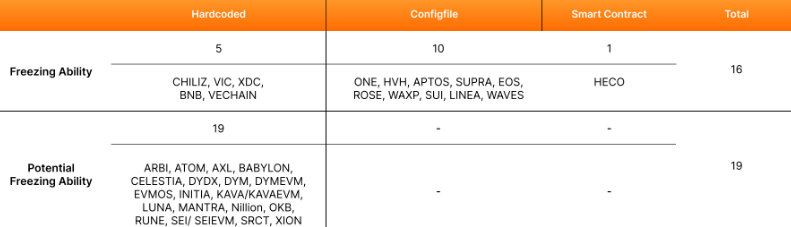
After analyzing 166 blockchain networks, the research team discovered that several—including BNB Chain, VeChain, and Sui—feature protocol-level mechanisms allowing developers, validators, or foundations to halt specific transactions or addresses.
“Even when designed to enhance security or prevent theft, these mechanisms raise fundamental questions about censorship resistance and decentralization,” the researchers noted in the report.


Three Mechanisms Behind Fund Freezing

The Bybit security team identified three distinct freezing methods across affected blockchains:

  1. Hardcoded Freezing / Public Blacklists – Embedded directly into the network’s source code, enabling developers to freeze wallets or tokens.
    • Networks: BNB Chain, VeChain, Chiliz, Viction, and XinFin’s XDC Network.
  2. Configuration File-Based Freezing / Private Blacklists – Managed via local configuration files like YAML, ENV, or TOML, typically controlled by validators or core teams.
    • Networks: Aptos, EOS, and Sui, among others.
  3. Onchain Smart Contract Freezing – Deployed via smart contracts that can manage or restrict specific addresses.
    • Example: Heco Chain (Huobi Eco Chain), which uses an onchain contract for blacklisting.
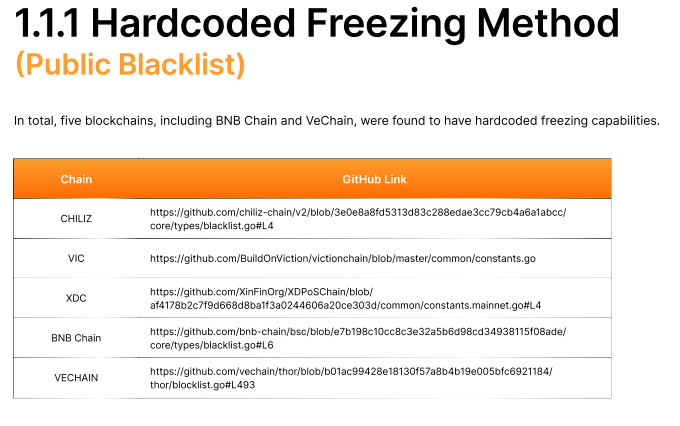
The researchers found that 10 of the 16 chains rely on configuration-based methods, while five include freezing directly in their source code.


Potential for More Chains to Adopt Freeze Controls

The study also highlighted 19 additional blockchains, particularly within the Cosmos ecosystem, that could easily implement freezing features through minor protocol changes.

The report drew attention to Cosmos’ module accounts, which operate under module logic instead of private keys, allowing developers to modify or restrict transaction behavior.

“Implementing such a change would require a hard fork and minor code adjustments — likely in the anteHandler file,” the report explained, adding that none of the Cosmos-based chains currently use this for fund control.


Security vs. Censorship: The Growing Trade-Off

While fund-freezing capabilities can aid in recovering stolen assets or preventing fraud, the Lazarus team warned that their existence could centralize power and undermine blockchain neutrality.

This revelation follows Bybit’s $1.5 billion cold wallet hack earlier this year, during which coordinated action with Circle, Tether, THORchain, and Bitget helped freeze roughly $42.9 million in stolen assets.

The incident underscores a complex tension: the desire for decentralized freedom versus the need for centralized security controls.

The findings from Bybit’s Lazarus Lab mark a pivotal moment for blockchain governance. As networks increasingly embed emergency controls and compliance modules, the crypto industry faces a fundamental question — can true decentralization coexist with administrative safeguards?

Disclaimer

This content is for informational purposes only and does not constitute financial, investment, or legal advice. Cryptocurrency trading involves risk and may result in financial loss.

logo

blockto.io

info@blockto.io

Blockto.io Copyright © 2025, All rights reserved

News
Rates
Buy
More
We use cookies to personalize content and ads, provide social media features, and analyze our traffic. In accordance with GDPR/AVG and EU cookie regulations, data is processed only with your consent. We may share information about your use of our website with our social media, advertising, and analytics partners, and you can manage or withdraw your consent at any time. View more
Cookies settings
Accept
Privacy & Cookie policy
Privacy & Cookies policy
Cookie name Active

Privacy Policy

At BitxJournal.com, we respect your privacy and are committed to protecting your personal data. This Privacy Policy explains how we collect, process, store, and protect personal information in accordance with the General Data Protection Regulation (GDPR) and AVG (EU privacy legislation).

1. Data Controller

BitxJournal.com acts as the data controller for all personal data processed through this website.

2. Personal Data We Collect

We may collect and process the following categories of data:

Personal Data

  • Name and email address (when you subscribe to newsletters or contact us)

Technical & Usage Data

  • IP address, browser type, operating system

  • Device information

  • Pages visited, referral sources, and interaction data

This data is collected via cookies, log files, and analytics technologies.

3. Legal Basis for Processing

We process personal data only when a lawful basis exists, including:

  • Consent – when you explicitly agree (e.g., cookies, newsletter sign-up)

  • Legitimate interest – to operate, secure, and improve our website

  • Legal obligation – when required by applicable laws

You may withdraw your consent at any time.

4. Purpose of Data Processing

Your data is processed for the following purposes:

  • Operating and maintaining the website

  • Improving content, usability, and performance

  • Sending newsletters or updates (only with consent)

  • Analyzing traffic and user behavior

  • Responding to inquiries or support requests

5. Cookies & Consent Management

We use cookies and similar technologies in compliance with EU Cookie Law.

  • Non-essential cookies are placed only after explicit user consent

  • Users may accept, reject, or manage cookie preferences at any time

  • Consent can be withdrawn without affecting prior lawful processing

Detailed cookie information is available in our Cookie Settings panel.

6. Third-Party Data Processing

We may share limited data with trusted third-party service providers, including:

  • Analytics providers (e.g., Google Analytics)

  • Advertising partners (for personalized or non-personalized ads)

These third parties act as data processors and process data only under contractual obligations compliant with GDPR/AVG.

7. International Data Transfers

Where data is transferred outside the European Economic Area (EEA), we ensure appropriate safeguards are in place, such as Standard Contractual Clauses (SCCs) or equivalent legal mechanisms.

8. Data Retention

We retain personal data only for as long as necessary to fulfill the purposes outlined in this policy or as required by law.

9. Data Security

We implement appropriate technical and organizational security measures to protect personal data against unauthorized access, alteration, disclosure, or destruction.

10. Your GDPR Rights

Under GDPR/AVG, you have the right to:

  • Access your personal data

  • Rectify inaccurate or incomplete data

  • Request data erasure (“right to be forgotten”)

  • Restrict or object to processing

  • Data portability

  • Withdraw consent at any time

  • Lodge a complaint with a supervisory authority

11. Changes to This Privacy Policy

We reserve the right to update this Privacy Policy at any time. Any changes will be posted on this page with a revised effective date.

12. Contact Information

For privacy-related inquiries or GDPR requests, contact:

📧 Email: support@blockto.io
🌐 Website: https://blockto.io

Save settings
Cookies settings