

Exchange pushes back against banking groups seeking restrictions on merchant incentives
A growing battle over stablecoin payment incentives has erupted in Washington, with Coinbase sharply criticizing major U.S. banking associations for urging regulators to restrict cashbacks, discounts and merchant rewards tied to stablecoin transactions. The crypto exchange argues that banning such incentives would be an overreach and contradicts both the intent and text of the GENIUS Act.
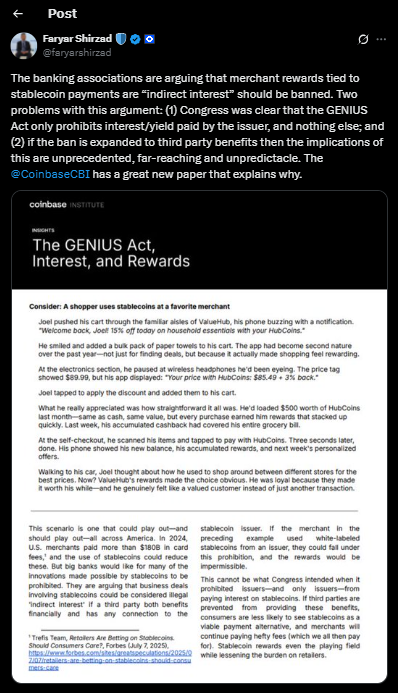
The dispute centers on whether incentives linked to stablecoin payments constitute an “indirect interest” — something prohibited for stablecoin issuers under the GENIUS Act. Banking groups claim that if a crypto exchange or affiliated third party offers customer rewards, it effectively functions as yield connected to the stablecoin’s issuer.
Coinbase’s chief policy officer Faryar Shirzad dismissed that interpretation as baseless.
“There is something un-American about bank lobbyists demanding regulators dictate what stablecoin users can and cannot do with their own money once it has been issued,” Shirzad wrote, urging regulators to “stick to the statutory text.”
Banks fear stablecoins could drain trillions in deposits
Financial institutions have long expressed concern that stablecoins could undercut the traditional deposit-based banking model. According to a U.S. Treasury analysis, widespread stablecoin adoption could pull more than $6.6 trillion out of the banking system — a shift that would reduce their lending power and weaken the foundation of deposit funding.
Banking groups argue that allowing stablecoin-linked rewards could accelerate this transition. Coinbase counters that opposition is more about protecting entrenched interests than safeguarding consumers.
The exchange says stablecoins could help dramatically lower the more than $180 billion in card fees paid by U.S. merchants in 2024.
Coinbase defends payment innovation
Shirzad warned that preventing third-party rewards would damage merchant adoption and keep the payments market locked into its current fee-heavy framework.
“If third parties cannot offer benefits, consumers will have fewer reasons to test stablecoin payments, and merchants will stay stuck paying inflated fees,” he said.
Exchanges stand to gain from stablecoin growth
Coinbase and other platforms benefit when stablecoin usage increases, as higher trading volume boosts revenue. Many exchanges also run crypto-backed cards offering cashback and spending rewards — incentives Shirzad believes could be put at risk if the banking groups’ interpretation prevails.
Still, he remains optimistic, saying that “common sense will prevail” as regulators evaluate the issue.
Disclaimer
This content is for informational purposes only and does not constitute financial, investment, or legal advice. Cryptocurrency trading involves risk and may result in financial loss.