
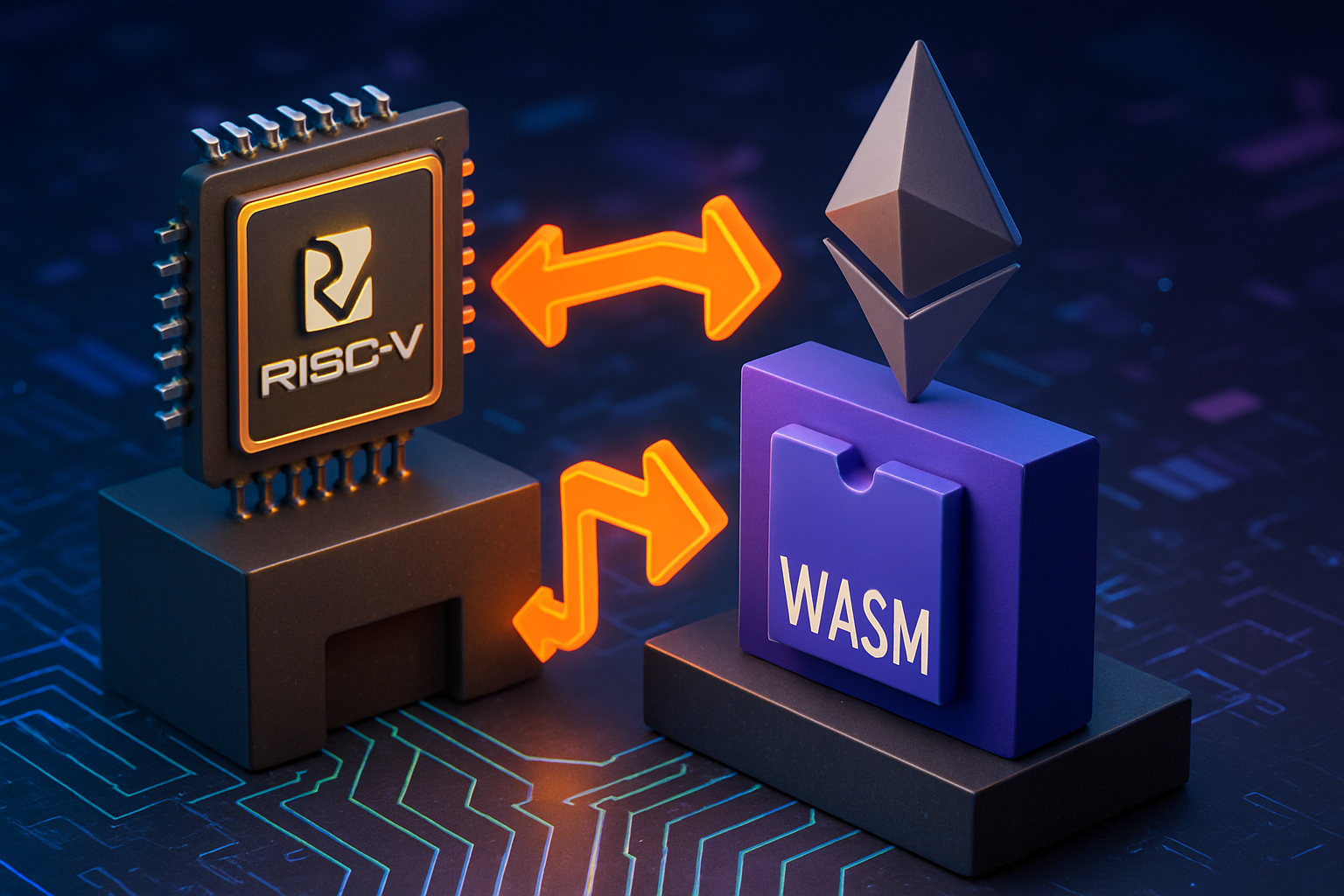
Arbitrum researchers argue that WebAssembly offers safer long-term flexibility for Ethereum’s execution layer than Vitalik Buterin’s preferred RISC-V architecture
A new technical debate has emerged within the Ethereum ecosystem after researchers from Offchain Labs, the core developers behind Arbitrum, challenged Vitalik Buterin’s proposal to shift Ethereum’s execution layer to the RISC-V instruction set architecture. Their analysis argues that WebAssembly (WASM) is a more reliable and future-proof choice for Ethereum’s Layer 1 smart contract format.
Offchain Labs Challenges RISC-V as Ethereum’s Smart Contract Foundation
In a detailed post published on Nov. 20, the researchers responded to Buterin’s earlier suggestion that adopting RISC-V could reduce zero-knowledge proving costs by up to 100x. While they agreed with the goal of improving proving efficiency, they emphasized that “one ISA cannot optimally serve both ZK-proving and smart contract delivery.”
The team — Mario Alvarez, Matteo Campanelli, Tsahi Zidenberg and Daniel Lumi — argued for a separation between two types of instruction formats:
- a delivery ISA (dISA) used for uploading and storing contracts on-chain
- a proving ISA (pISA) used by ZK-virtual machines
They underlined that these do not need to be the same, a distinction they say is crucial for Ethereum’s long-term adaptability.
Prototype Shows WASM Can Work With RISC-V Proving
Offchain Labs revealed that Arbitrum already uses a hybrid model. Stylus smart contracts are written in WASM, but the system still compiles WASM to RISC-V on the backend for ZK-proof generation.
The researchers wrote: “We can ZK-prove real-world blocks today in a blockchain that uses WASM as a dISA, by using a RISC-V-based ZK-VM as a backend.”
This demonstrates that Ethereum can benefit from RISC-V proving without locking its entire execution architecture to it.
Concerns About Lock-In and Rapidly Evolving Proving Technology
The team cautioned that selecting RISC-V for Layer 1 could lock Ethereum into a single hardware-oriented architecture at a time when ZK-VM innovation is accelerating. They noted that RISC-V itself is shifting quickly, moving from 32-bit to 64-bit implementations — a sign that the ecosystem is still in transition.
They also highlighted that ZK proving costs have already fallen to about $0.025 per Ethereum block, reducing the urgency to optimize exclusively for proving efficiency. For builders earning gas fees and MEV, they argue, the proving cost is “minimal”.
Why WASM May Be the Better Long-Term Choice
The researchers emphasized several advantages of WASM, including:
- its structured and safe design, enabling code changes without breaking existing contracts
- efficient execution on standard hardware, unlike RISC-V which most nodes must emulate
- strong validation rules that prevent type errors and common vulnerabilities
- a massive and mature tooling ecosystem proven across countless execution environments
They concluded that “WASM can be a sort of Internet Protocol for smart contracts,” serving as a universal layer between diverse programming languages and execution backends.
The debate over Ethereum’s future execution architecture is far from settled, but Offchain Labs’ argument strengthens the case for WASM’s flexibility, safety, and compatibility. As ZK-proof technology rapidly advances, Ethereum developers now face a critical question: whether to embrace a hardware-oriented ISA like RISC-V or rely on WASM as a more adaptable foundation for the coming decades.
Disclaimer
This content is for informational purposes only and does not constitute financial, investment, or legal advice. Cryptocurrency trading involves risk and may result in financial loss.