
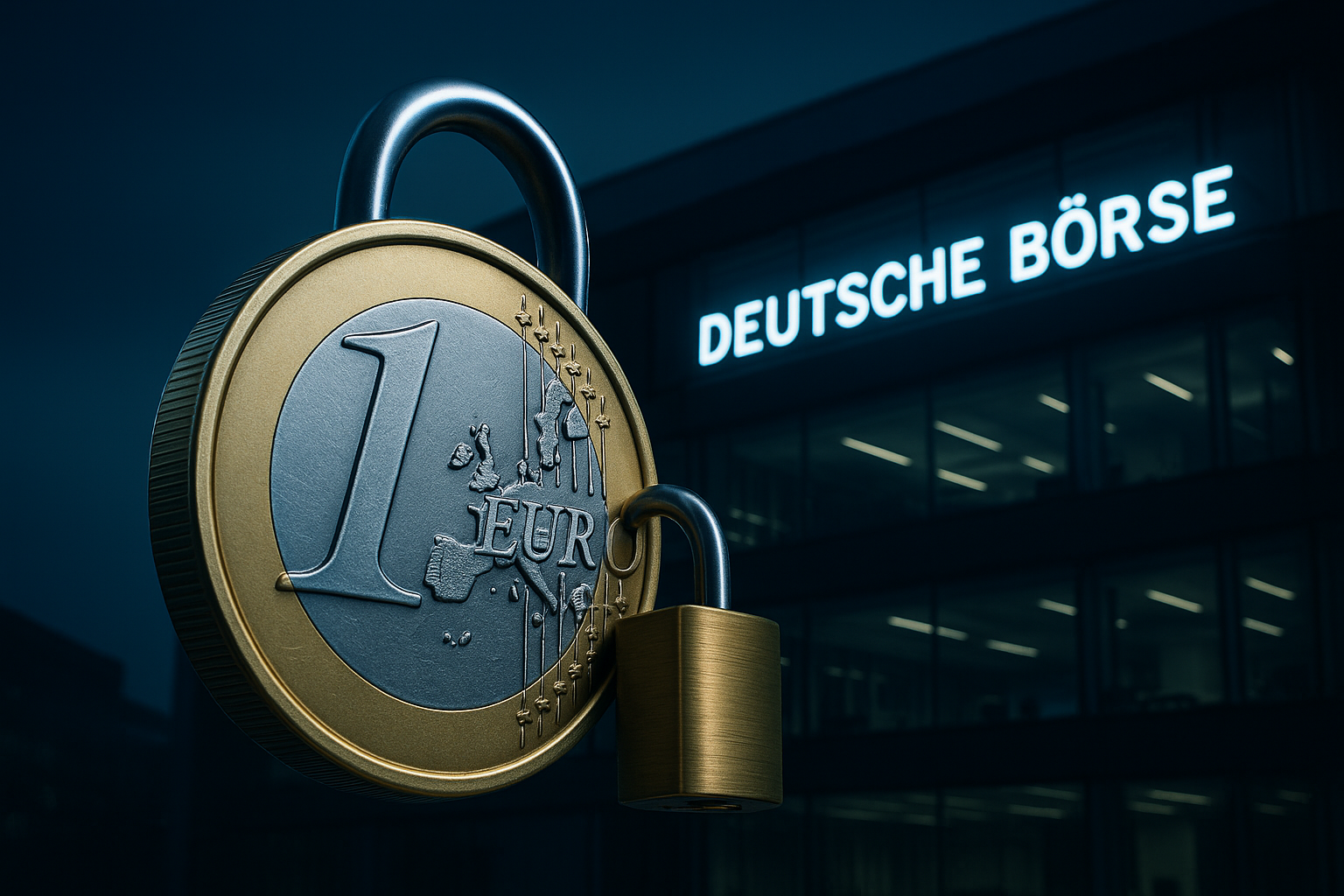
By integrating AllUnity’s EURAU, the German exchange giant deepens its multi-issuer euro-stablecoin strategy aligned with MiCA, signaling Europe’s increasing institutional shift toward on-chain finance.
Deutsche Börse has taken another major step in its digital-asset expansion, confirming plans to integrate EURAU, the euro-pegged stablecoin issued by AllUnity. This marks the exchange operator’s third euro stablecoin initiative, following earlier partnerships with Circle’s EURC and Societe Generale-Forge’s EURCV. The move underscores a broader push across the European Union to bring institutional-grade stablecoins into mainstream market infrastructure.
Deutsche Börse Sets Up Full-Spectrum Stablecoin Integration
According to Wednesday’s announcement, Deutsche Börse will begin by offering institutional custody of EURAU through Clearstream, its central securities depository. The plan includes a future “integration of the euro stablecoin across the entire service portfolio,” signaling a long-term commitment to embedding tokenized euros into trading, settlement, and liquidity ecosystems.
The integration taps into a sizable market: Deutsche Börse’s domestic equity market represents $2.23 trillion in capitalization with 474 listed companies, according to World Federation of Exchanges data.
A Multi-Issuer Strategy to Lead Europe’s Stablecoin Market
With EURAU added to the roster, Deutsche Börse now covers three distinct categories of euro stablecoins:
- EURAU (AllUnity) — issued by a BaFin-licensed German e-money institution
- EURCV (Societe Generale-Forge) — backed by a major EU banking group
- EURC (Circle) — issued by a leading U.S. digital-asset firm
Analysts say this “all-fronts” approach reflects a desire for resiliency and regulatory alignment. One expert noted that “no single issuer is likely to dominate the euro-stablecoin market under MiCA, so infrastructure operators want broad interoperability.”
AllUnity CEO Alexander Höptner said the partnership is aimed at “making on-chain cross-border payments and digital assets accessible to institutional market participants.”
Stephanie Eckermann of Deutsche Börse added that the goal is to “build a seamless bridge between the established financial world and the future of digital assets,” emphasizing that institutional-grade stablecoins play a central role in that transition.
EU Stablecoin Adoption Rises Under MiCA — But From a Low Base
The initiative aligns squarely with the European Union’s MiCA regulatory framework, fully implemented at the end of 2024. The announcement called the project a “tangible step toward digitizing European markets and enhancing settlement and liquidity processes.”
Höptner also noted that “Europe is taking a global lead in regulated digital finance.”
Still, despite momentum, current adoption remains modest. The European Central Bank recently stated that stablecoin-related risks are limited in the euro area due to low usage and strong regulatory safeguards.
Some policymakers argue that euro-denominated stablecoins are needed to reduce dependence on dollar-backed tokens. As Pierre Gramegna, managing director of the European Stability Mechanism, recently said, “Europe should not be dependent on US dollar-denominated stablecoins.”
Traditional Finance Joins the Race
Momentum is growing across European financial institutions. In the past two months:
- ODDO BHF launched a MiCA-compliant euro stablecoin.
- A consortium of nine major European banks — including ING and UniCredit — announced a new euro-pegged token under MiCA.
With Deutsche Börse now integrating EURAU alongside EURC and EURCV, the exchange giant is building one of the most comprehensive stablecoin infrastructures in the EU — a move likely to accelerate institutional settlement and tokenized-asset adoption across the region.
Disclaimer
This content is for informational purposes only and does not constitute financial, investment, or legal advice. Cryptocurrency trading involves risk and may result in financial loss.