

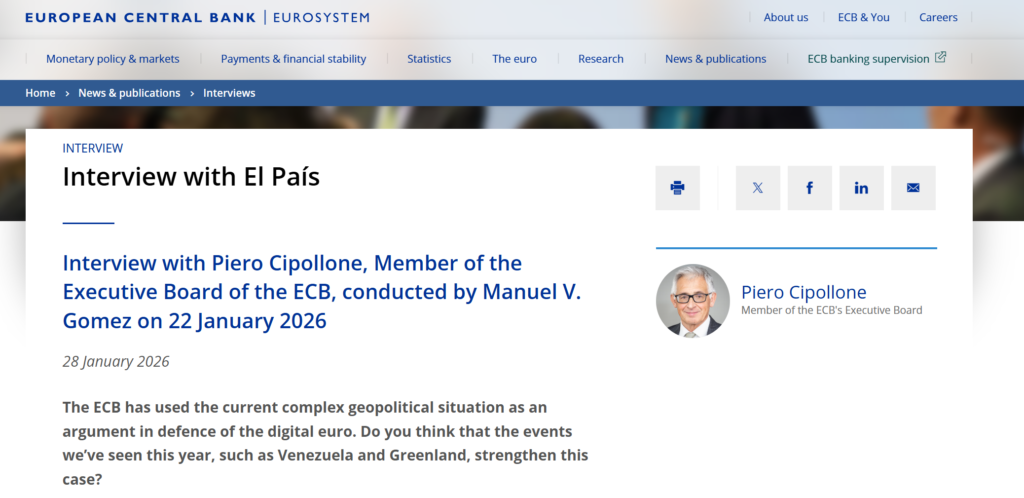
Growing geopolitical tensions are reinforcing the need for a European-controlled digital payments system, according to a senior European Central Bank official. The proposed digital euro is increasingly viewed as a strategic response to a world where financial infrastructure is becoming “weaponised.”
An ECB executive board member described the digital euro as public money in digital form, designed to complement cash and adapt to Europe’s rapidly changing payment habits. Cash usage has declined sharply, representing 24% of daily transaction value in 2024, down from 40% in 2019, highlighting the shift toward digital payments and e-commerce.
Reducing Dependence on Non-European Providers
The ECB argues that Europe must avoid excessive reliance on foreign payment schemes. A digital euro built on European technology and infrastructure would ensure that retail payments remain fully under European control, even amid rising global instability.
The digital euro would hold legal tender status, meaning merchants that already accept electronic payments would be required to accept it, ensuring widespread usability across the EU.
Calls to delay the project in favor of private solutions were rejected, with officials noting that pan-European private payment systems have failed to materialize despite years of encouragement. A single, open digital euro standard is seen as a catalyst for banks and fintechs to finally build a unified EU retail payments layer, particularly for online commerce.
Supporters warn that further delays could deepen Europe’s dependence on dominant non-European payment providers, weakening long-term financial sovereignty.
Disclaimer
This content is for informational purposes only and does not constitute financial, investment, or legal advice. Cryptocurrency trading involves risk and may result in financial loss.