

New research from economists affiliated with the Federal Reserve suggests that data from the prediction market platform Kalshi could improve how policymakers assess market expectations around key economic events. In a paper released on Feb. 12, researchers examined whether Kalshi’s event-based contracts provide a more responsive and detailed measure of macroeconomic sentiment compared to traditional surveys and derivatives markets.
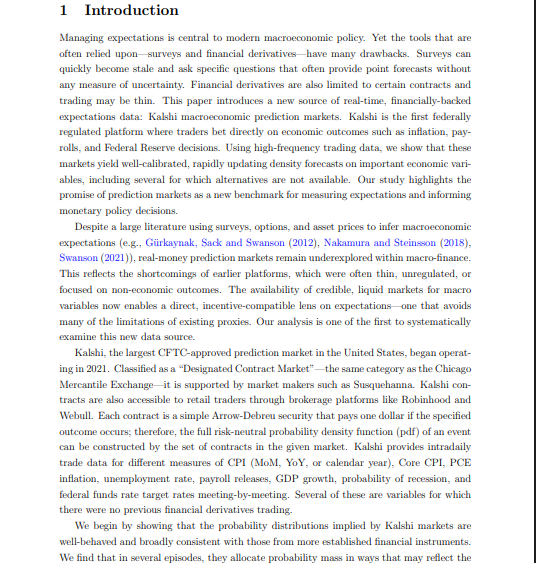
The study argues that managing expectations is central to modern monetary policy, yet commonly used tools often lag behind fast moving developments. Kalshi’s markets, which allow participants to trade on outcomes such as inflation readings, payroll data, gross domestic product growth, and Federal Open Market Committee (FOMC) rate decisions generate continuously updated probability estimates.
Risk-Neutral Probability Models and FOMC Decisions
According to the researchers, Kalshi data can be used to construct risk neutral probability density functions tied directly to specific FOMC meetings. This could offer policymakers a clearer picture of how markets price potential rate changes in real time.
The paper highlights instances where implied probabilities shifted sharply following public remarks from Federal Reserve governors and after the release of stronger than expected employment data. Researchers conclude that Kalshi’s high frequency market signals may provide one of the fastest-updating benchmarks currently available for tracking macroeconomic expectations.
Disclaimer
This content is for informational purposes only and does not constitute financial, investment, or legal advice. Cryptocurrency trading involves risk and may result in financial loss.