

A recent study from the Cambridge Centre for Alternative Finance suggests that the global Bitcoin network is highly resilient to disruptions in undersea internet infrastructure. Researchers analyzed peer to peer network data from 2014 to 2025 alongside 68 verified submarine cable fault events to assess how failures might affect the blockchain network.
Their findings indicate that between 72% and 92% of international submarine cables would need to fail before more than 10% of Bitcoin nodes become disconnected. Since undersea fiber-optic cables carry roughly 99% of global internet traffic, the results highlight the network’s ability to withstand widespread but random infrastructure disruptions.
Targeted Attacks Could Pose Greater Risk
While random failures appear unlikely to significantly impact the network, the study notes that targeted attacks on critical cable chokepoints could be more damaging. In such cases, only 5% to 20% of key connections would need to fail to cause meaningful disruptions across parts of the network.
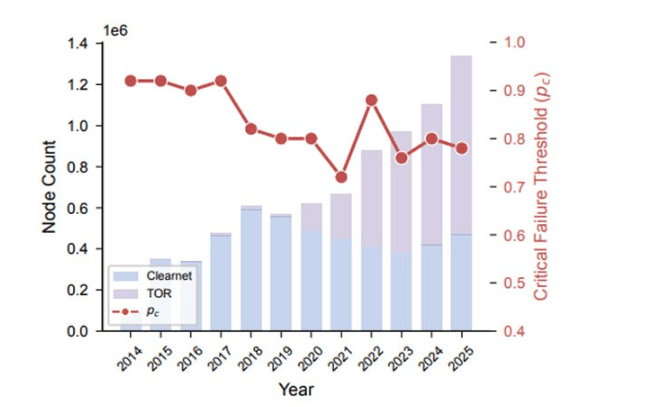
The research also highlights the role of Tor in improving resilience. Approximately 64% of Bitcoin nodes operate through Tor, which hides their physical locations and routes traffic through multiple encrypted relays.
Historical analysis showed that 87% of known cable faults caused less than a 5% impact on nodes, with almost no measurable correlation between cable outages and bitcoin price movements.
Disclaimer
This content is for informational purposes only and does not constitute financial, investment, or legal advice. Cryptocurrency trading involves risk and may result in financial loss.