
The Crypto Fear and Greed Index continues to reflect deep market pessimism, registering a reading of 11, firmly within the “extreme fear” zone. This condition has persisted for 12 consecutive days, with sentiment remaining largely negative since Jan. 28, aside from a short recovery between March 17 and March 18.
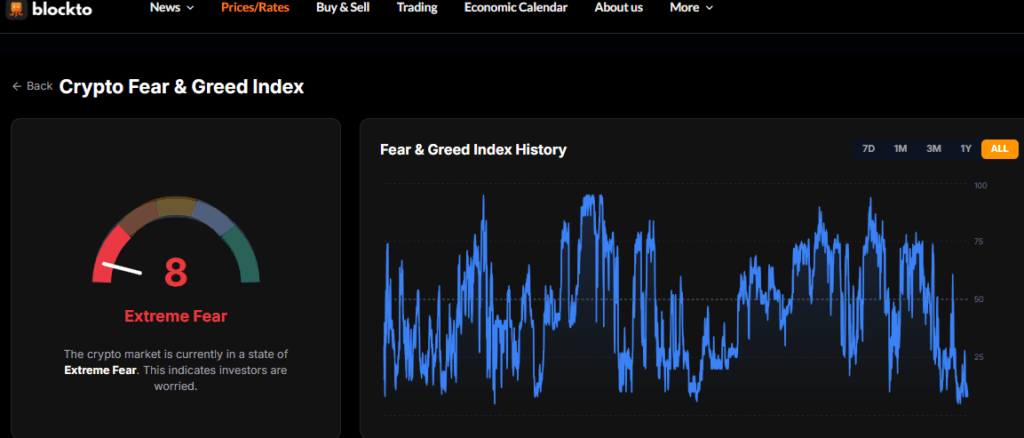
The index, which tracks volatility, trading volume, social sentiment, and market momentum, is widely used as a contrarian indicator. Historically, extended periods of extreme fear have been viewed as potential dip-buying opportunities. However, prolonged bearish market conditions since January have led some traders to question whether the traditional signal remains reliable.
Crypto commentator Rand Group highlighted a disconnect between investor sentiment and price action. Ongoing concerns tied to U.S. interest rates and Israel–Iran war developments have kept sentiment weak, yet Bitcoin selling pressure has not significantly increased, suggesting underlying resilience.
Onchain Metrics Point to Reduced Speculation and Possible Market Bottom
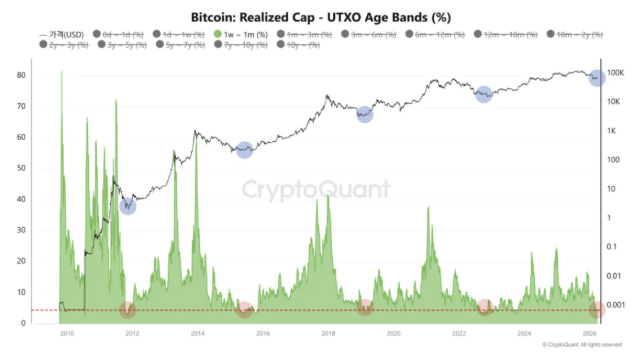
Onchain data suggests calmer trading activity beneath the surface. Crypto analyst MAC_D reported that the proportion of short-term Bitcoin holders, particularly those holding between one week and one month, has dropped to 3.98%. In previous market cycles, levels below 4% have often coincided with periods when markets were approaching a bottom.
Lower short-term participation indicates fewer rapid trades and reduced speculative demand. At the same time, long-term holders now control a larger portion of the circulating supply, signaling continued accumulation even during periods of negative sentiment.
Bitcoin Weakness Against Equities Adds Market Uncertainty
Bitcoin researcher Axel Adler Jr. observed that Bitcoin’s short-term correlation with the S&P 500 has weakened, with the 13-week correlation slipping below zero. The BTC-to-S&P ratio has also trended lower throughout 2026, reflecting Bitcoin’s continued underperformance relative to equities.
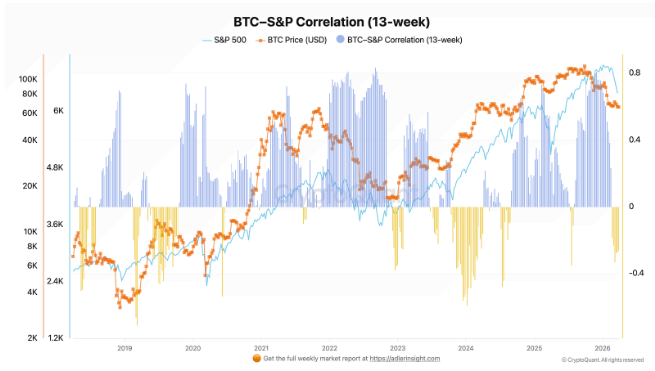
Although Bitcoin briefly rallied to $76,000 on March 17, the move failed to establish sustained upward momentum. Weak participation from smaller investors suggests that Bitcoin is currently being treated as a higher-risk asset compared with traditional stocks.
Despite this relative weakness, the combination of stable support above $60,000, limited selling pressure, and increased whale dominance suggests that Bitcoin may be entering a quiet accumulation phase, even as overall sentiment remains deeply negative.
Disclaimer
This content is for informational purposes only and does not constitute financial, investment, or legal advice. Cryptocurrency trading involves risk and may result in financial loss.