

Bitcoin continues trading within a tight $60,000 to $73,000 range, showing resilience despite challenging global conditions. Rising Brent crude oil prices to levels last seen in 2008, ongoing conflict involving the United States, Israel and Iran, and volatility in traditional markets including a 3.95% year-to-date decline in the S&P 500 have created a difficult backdrop.
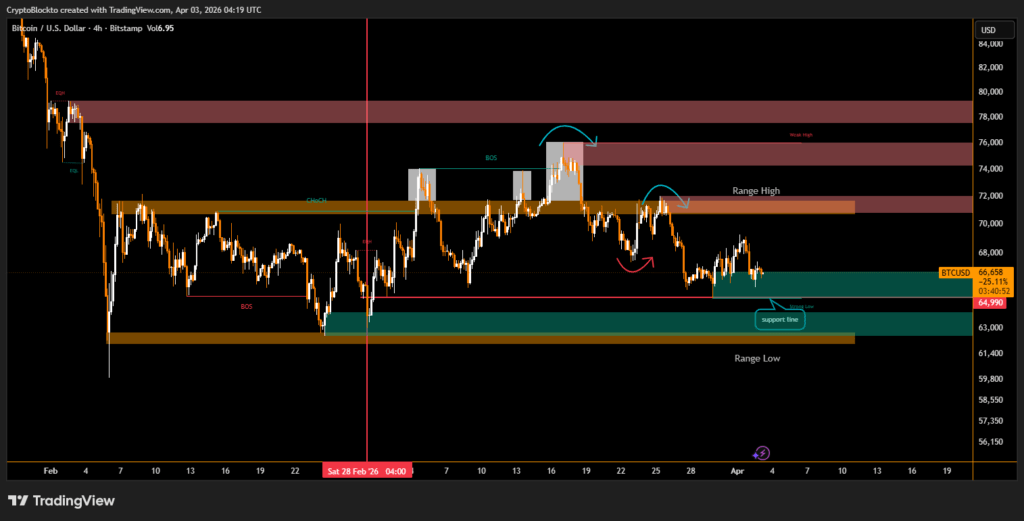
Buyers have repeatedly stepped in near the $60,000 level, keeping it intact as a key support zone. However, technical indicators show a bearish continuation structure forming on the daily chart. One bearish pattern was confirmed on Jan. 20, when Bitcoin corrected toward $60,014, and a second bear flag has developed since Feb. 8, rejecting multiple rally attempts at resistance.
Analysts emphasize that a multi-day close above $76,000 is necessary to invalidate the bearish structure. Ideally, this would include two to three consecutive daily closes above that level, followed by a successful retest around $75,000, confirming a resistance to support flip.
Key Support Levels and Liquidation Risks in Focus
Market technician Aksel Kibar has warned that a breakdown below the lower boundary of the current pattern could push Bitcoin toward $52,500. Data tracking leveraged positions also highlights increased liquidation risk if Bitcoin falls into the $63,000 to $65,000 range, where a concentration of long positions is located.
Market demand across spot and futures markets remains relatively flat, with aggregated open interest staying below $20 billion, a level last seen in early February when Bitcoin traded near $79,000. Below the current support range, a liquidity gap exists until roughly $57,500 to $56,000, where the next cluster of margin positions begins.
Until a strong catalyst emerges, analysts expect Bitcoin to continue consolidating within its broad range, with $60,000 acting as critical support and $70,000 remaining a major resistance barrier.
Disclaimer
This content is for informational purposes only and does not constitute financial, investment, or legal advice. Cryptocurrency trading involves risk and may result in financial loss.