

Stablecoins remained one of the strongest segments of the crypto market in the first quarter, with total supply rising by about $8 billion to reach a record $315 billion, according to data from.CEX.io Although this represented the slowest expansion since the fourth quarter of 2023, the increase came during a period when the broader digital asset market weakened.
Investor behavior showed a defensive shift toward stable assets. Stablecoins accounted for approximately 75% of total crypto trading volume in Q1, the highest level recorded so far. At the same time, overall stablecoin transaction volume exceeded $28 trillion, reinforcing their role as a major liquidity layer across digital asset markets.
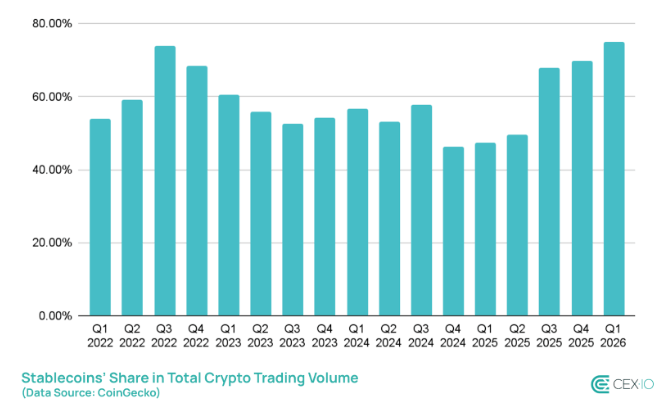
Despite the strong activity levels, retail participation showed signs of decline. Retail-sized transfers fell by 16%, marking the steepest quarterly drop on record. Meanwhile, automated systems dominated usage, with bots responsible for roughly 76% of all stablecoin transaction volume, suggesting increased reliance on algorithmic trading, arbitrage, and liquidity provisioning.
Diverging Trends Between Major Stablecoin Issuers
Data from the quarter also highlighted a widening gap between leading stablecoin issuers. The supply of USDC, issued by Circle, increased by approximately $2 billion, while USDT, issued by Tether, declined by about $3 billion. This marked the first significant divergence between the two since the second quarter of 2022 during earlier bearish market conditions.

Much of the broader growth in stablecoin issuance came from yield-bearing products, a segment now valued at around $3.7 billion, with daily trading volumes exceeding $100 million. These products have drawn regulatory attention in the United States, particularly as lawmakers debate crypto market structure rules and traditional banks raise concerns about stablecoins offering interest-like returns.
Disclaimer
This content is for informational purposes only and does not constitute financial, investment, or legal advice. Cryptocurrency trading involves risk and may result in financial loss.