
Tokenized finance could make market crises unfold faster than regulators can respond, according to a report released by the International Monetary Fund (IMF). IMF Financial Counselor Tobias Adrian described tokenization as a structural shift in financial architecture rather than a marginal efficiency gain, warning that the removal of traditional settlement delays could increase systemic risk.
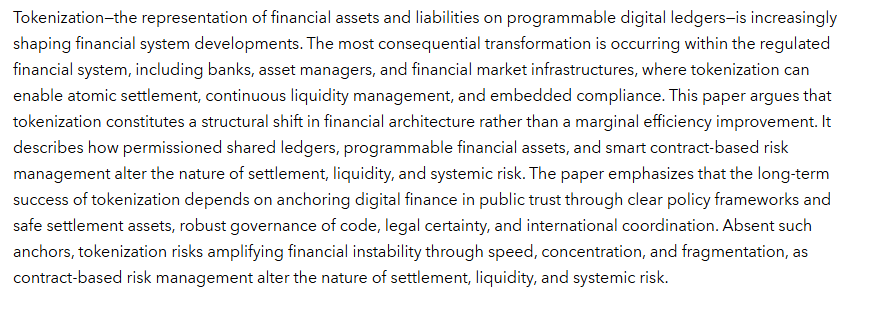
Traditional two-day settlement cycles currently provide time for central banks to mobilize liquidity, net exposures, and intervene before trades are finalized. Adrian argued that tokenized systems remove these buffers by enabling instant settlement. Automated margin calls and algorithmic feedback loops in 24/7 markets could compress response time, while existing central bank emergency lending tools were designed for business-day cycles, not continuous operations.
Stablecoin Risks and Legal Uncertainty in Tokenized Systems
Adrian compared stablecoins to money market funds, noting that while they function well in stable conditions, they can become vulnerable to runs when confidence declines. He stated that stablecoins without access to central bank reserves require higher liquidity buffers and conservative margining to offset settlement asset risk. Even fully backed stablecoins depend on issuers’ operational capacity and the liquidity of underlying government securities markets.
The report also noted that tokenized lending has not grown meaningfully due to blockchain pseudonymity, which limits credit assessment and forces lenders to rely on overcollateralization. Adrian challenged the “code is law” principle, arguing that legal mandates for stability must override automated execution. He recommended predefined override mechanisms in critical smart contracts.
Three Future Scenarios and Policy Recommendations
The IMF outlined three scenarios for tokenized finance: a coordinated system anchored by wholesale central bank digital currencies, a fragmented network of incompatible national platforms, or a system dominated by private stablecoins that weakens public backstops.
A five-pillar roadmap recommended settlement anchored in safe money, consistent regulation across equivalent activities, legal certainty for tokenized assets, interoperability standards, and adapting central bank tools for continuous-operation financial environments.
Disclaimer
This content is for informational purposes only and does not constitute financial, investment, or legal advice. Cryptocurrency trading involves risk and may result in financial loss.