

Ether treasury companies may need liquid staking and other active yield strategies to outperform staked Ether ETFs, according to Kean Gilbert, head of institutional relations at Lido Finance, speaking at ETHCC 2026. Liquid staking allows ETH holders to stake tokens while receiving a transferable token that can be deployed in DeFi. Gilbert suggested strategies such as posting ETH as collateral and borrowing against it to generate higher returns than passive staking products.
U.S.-Listed Staked ETH Products
Current ETFs include the REX-Osprey ETH + Staking ETF (launched September 2025), Grayscale Ethereum Staking ETF and Ethereum Staking Mini ETF, and BlackRock iShares Staked Ethereum Trust ETF (introduced March 12). Net staking rewards vary: Grayscale ETHE reported 2.26% as of April 6, Grayscale ETH 2.56%, and native ETH staking yields about 2.72% annually.
Liquid Staking Adoption by Treasuries
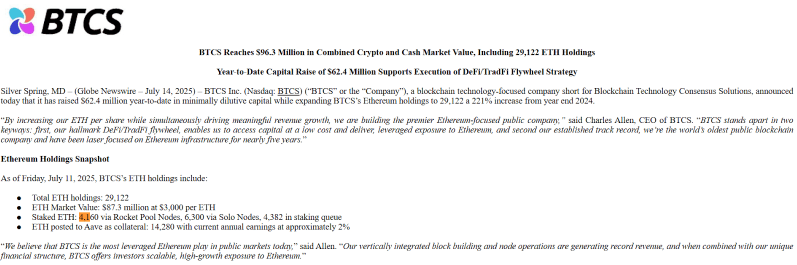
Sharplink Gaming, the second-largest corporate ETH holder, earned 14,516 ETH ($30.8 million) in staking rewards, with 33% from liquid staking. BTCS Inc. liquid staked 4,160 ETH ($8.8 million) through Rocket Pool, out of total holdings of 29,122 ETH. Jimmy Xue, co-founder of Axis, emphasized that treasuries focus on active deployment and basis trading, which passive ETFs cannot deliver.
These strategies aim to provide investors with returns beyond traditional staking products, reflecting growing adoption of liquid staking in institutional Ether treasuries.
Disclaimer
This content is for informational purposes only and does not constitute financial, investment, or legal advice. Cryptocurrency trading involves risk and may result in financial loss.