
South Korea’s ruling Democratic Party of Korea is moving forward with plans to bring tokenized real-world assets (RWAs) and stablecoins under existing financial regulations as part of the proposed Digital Asset Basic Act. The move signals the country’s intent to formalize oversight of digital assets while encouraging responsible innovation.
Digital Asset Basic Act to Integrate RWAs Into Financial Rules
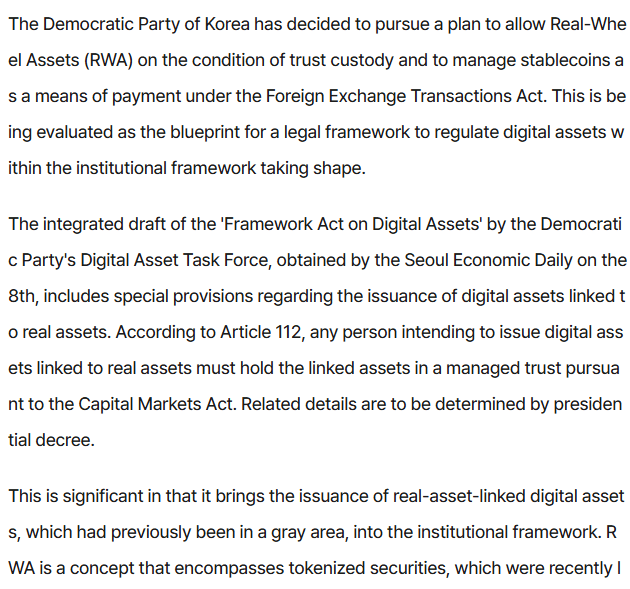
According to policy details, issuers of tokenized RWAs will be required to deposit linked assets into a managed trust, in line with requirements under the Capital Markets Act. Additional operational details are expected to be outlined through a presidential decree.
The proposal also classifies stablecoins as a means of payment under the Foreign Exchange Transactions Act, placing oversight responsibility on foreign exchange authorities. Small-scale stablecoin payments for goods and services will be exempt from foreign exchange reporting rules, a step viewed as supporting everyday stablecoin use while maintaining supervision of larger transactions.
Stablecoin Yield Ban and Technical Standards Proposed
The legislation includes provisions to ban yield on idle stablecoin balances, reflecting similar policy debates underway in other major markets. The Financial Services Commission, South Korea’s financial watchdog, will also be tasked with creating technical interoperability standards and establishing a unified digital asset disclosure system.
The Digital Asset Basic Act, considered South Korea’s second major regulatory framework for digital assets, has experienced legislative delays that pushed its original 2025 deadline, but authorities continue working toward implementation.
Disclaimer
This content is for informational purposes only and does not constitute financial, investment, or legal advice. Cryptocurrency trading involves risk and may result in financial loss.