

Crypto markets are entering a new phase where institutional investors are leading accumulation, while retail participation remains unusually weak, according to Exodus CEO JP Richardson. He stated that financial institutions have “accelerated” their involvement this year, marking what could be the first cycle where institutions experience a bull market without significant retail participation.
Richardson pointed to multiple signs of institutional expansion, including a stablecoin market capitalization reaching an all-time high, the launch of Morgan Stanley’s Bitcoin ETF, Charles Schwab opening a waitlist for spot Bitcoin trading, Franklin Templeton expanding into digital assets, and Fannie Mae exploring Bitcoin-backed mortgages. He noted that unlike previous cycles in 2018 and 2022, institutions are not exiting alongside retail investors but continuing to accumulate.
Retail Investors Exit Amid Economic Pressure and Low Participation
Crypto analyst and YouTuber Michael van de Poppe said retail interest has sharply declined, citing rising living costs and inflation as key reasons. He described the current environment as an “institutional cycle” rather than a retail-driven one, suggesting it may last longer and progress more gradually.
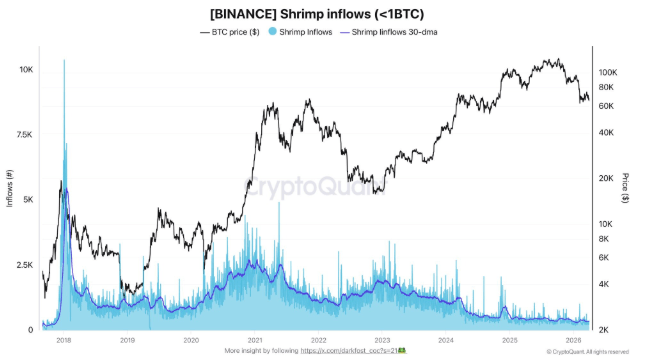
Data from analyst Darkfost shows retail activity on platforms like Binance has dropped to a nine-year low, with inflows from wallets holding less than 1 BTC reaching record lows. Some retail capital may have rotated into equities and commodities, which have recently performed strongly.
Market Sentiment Remains Macro-Driven and Fragile
Analysts note that short-term crypto sentiment is heavily influenced by macroeconomic factors such as oil prices, inflation expectations, and the US dollar. While near-term volatility remains elevated, some analysts believe structural institutional demand could support longer-term stability despite weak retail participation.
Disclaimer
This content is for informational purposes only and does not constitute financial, investment, or legal advice. Cryptocurrency trading involves risk and may result in financial loss.