

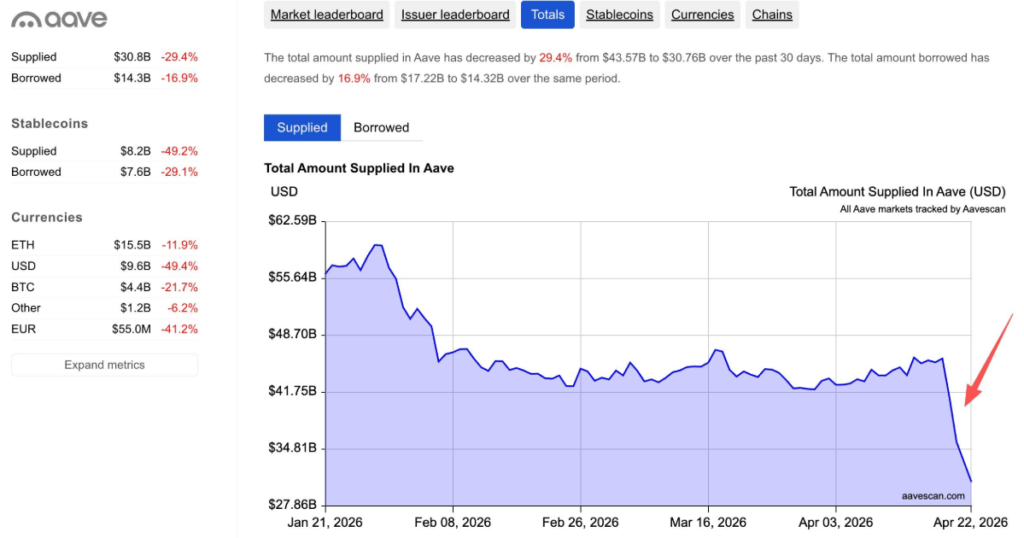
Decentralized lending protocol Aave has experienced a significant liquidity outflow, with approximately $15.1 billion withdrawn in just 3.5 days, according to on chain analyst EmberCN. Total deposits on the platform reportedly fell from $48.5 billion to $30.7 billion, representing nearly one-third of its capital base exiting in a short period.
The sudden movement highlights rapid capital rotation within decentralized finance lending markets, where large liquidity shifts can quickly alter yields, risk exposure, and borrowing capacity.
Mixed Performance Across Competing Lending Protocols
While Aave saw heavy withdrawals, other lending platforms showed divergent trends. Morpho recorded a decline in total deposits from $11.7 billion to $10.2 billion, marking about $1.5 billion in outflows following market stress linked to the rsETH incident.
In contrast, Spark saw strong inflows, with SparkLend total value locked rising from $1.9 billion to $3.2 billion, gaining roughly $1.3 billion in new deposits during the same period.
Liquidity Rotation Driven by Large Investors
On-chain analysis suggests that capital leaving Aave has partially shifted into Spark, with large holders and institutional participants contributing to the inflows. Reports indicate that major whale activity helped accelerate this rotation, as funds moved between lending markets in search of more stable yields and reduced risk exposure.
The contrasting flows across Aave, Morpho, and Spark highlight increasing volatility within decentralized lending markets, where liquidity can shift rapidly in response to protocol events and perceived risk. The recent movement underscores how large scale DeFi capital remains highly reactive, with liquidity migrating quickly between platforms based on confidence, yield conditions, and security concerns.
Disclaimer
This content is for informational purposes only and does not constitute financial, investment, or legal advice. Cryptocurrency trading involves risk and may result in financial loss.