

The emergence of Anthropic’s Mythos model is forcing decentralized finance (DeFi) developers to rethink long-standing security priorities. For years, most crypto security strategies focused on identifying bugs in smart contracts. However, Mythos introduces a new approach by simulating complex adversaries capable of linking multiple small weaknesses into larger attack chains.
Security leaders, including Paul Vijender at Gauntlet, say the biggest risks may now lie in infrastructure layers such as key management systems, signing tools, bridges, and oracle networks. These components often sit outside traditional audit frameworks but are essential to maintaining secure blockchain operations.
Recent events highlight these vulnerabilities. Vercel disclosed a breach linked to a compromised Google Workspace connection involving a third-party AI tool called Context.ai, prompting crypto firms to rotate exposed credentials.
AI Simulations Reveal Systemic Risks Across DeFi Networks
Unlike traditional tools that search for known bugs, Mythos maps relationships between interconnected protocols. This capability is especially important in composable DeFi systems, where protocols rely on shared liquidity, oracles, and bridges.
Large financial institutions such as JPMorgan Chase are already exploring AI-driven stress testing methods, while crypto exchanges including Coinbase and Binance have reportedly evaluated Mythos for security testing.
One example of systemic risk occurred during the Hyperbridge attack, where attackers minted roughly $1 billion worth of bridged Polkadot tokens on Ethereum by exploiting message verification flaws.
Continuous AI Auditing Becomes Essential for DeFi Security
Industry leaders increasingly agree that AI will strengthen both attackers and defenders. Stani Kulechov of Aave Labs described AI as an evolution of existing threats rather than a completely new challenge.
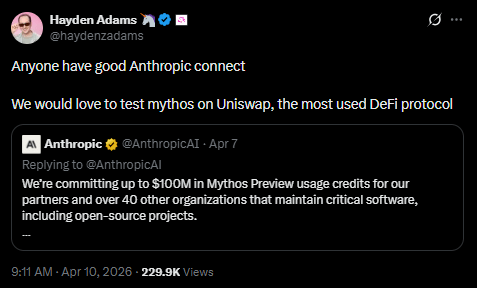
Meanwhile, Hayden Adams from Uniswap Labs noted that AI tools can help projects stress test systems before launch.
Experts believe the long-term effect will be a widening divide between projects that invest heavily in AI-driven security and those that rely on outdated audit methods. Continuous monitoring, simulation, and real-time defense strategies are quickly becoming standard expectations in the rapidly evolving DeFi ecosystem.
Disclaimer
This content is for informational purposes only and does not constitute financial, investment, or legal advice. Cryptocurrency trading involves risk and may result in financial loss.