
In a significant development for the stablecoin ecosystem, Tether (USDT) on the TRON blockchain has once again overtaken Ethereum’s USDT supply, breaking a six-month pattern. This shift reflects changing user preferences driven by transaction speed, cost-efficiency, and growing adoption in cost-sensitive regions.


Stablecoins Across Blockchains: A Quick Overview

Tether (USDT) is the largest stablecoin in the world and is issued on multiple blockchains such as Ethereum, TRON, Binance Smart Chain, and Solana. While the token value remains pegged to the U.S. dollar across chains, the user experience varies significantly depending on the network.

Ethereum has long dominated due to its smart contract capabilities and first-mover advantage. However, high fees and congestion have become recurring pain points, prompting users to explore alternatives like TRON, which offers lower costs and faster transactions.

Why Is TRON USDT Gaining Traction?

TRON’s growing dominance in USDT circulation can be attributed to several key factors:

  • Low Fees: TRON’s minimal transaction costs make it ideal for frequent and smaller transfers, especially in regions with limited banking infrastructure.
  • High Throughput: The TRON network confirms transactions within seconds, offering a better user experience compared to Ethereum’s slower confirmation times.
  • Adoption in Emerging Markets: TRON is especially popular in countries across Asia, Africa, and Latin America, where stablecoins are used for savings, payments, and remittances.

This combination of affordability and speed makes TRON the preferred blockchain for users focused on day-to-day transactions rather than advanced smart contract functionality.


Recent Data: USDT Supply Breakdown

As of mid-May 2025, blockchain analytics show:

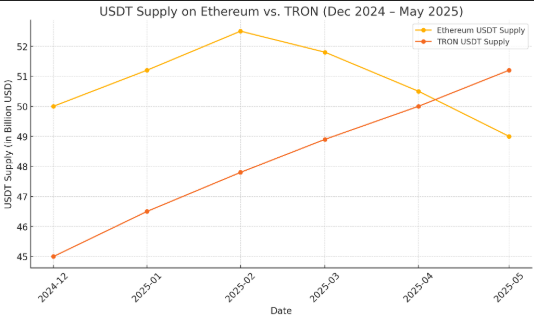
  • USDT on TRON: Over $51 billion
  • USDT on Ethereum: Approximately $49 billion
  • Total USDT Supply (across all blockchains): Exceeds $110 billion

This reversal marks the first time since late 2024 that TRON leads Ethereum in circulating USDT. The last time TRON held the top spot was about six months ago, highlighting the fluctuating nature of stablecoin activity across networks.


User Behavior Signals a Broader Trend

This shift also reflects a larger pattern in the crypto space. Users are becoming more utility-driven, selecting networks based on efficiency, cost, and accessibility, rather than sticking to one ecosystem.

Ethereum still leads in decentralized applications (dApps), NFTs, and complex DeFi protocols. However, for stablecoin transfers — especially for payments or remittances — TRON is winning favor due to its superior transaction economics.

Exchanges and wallets have also contributed to this shift by prioritizing TRON-based USDT withdrawals because of reduced fee liabilities, encouraging broader user adoption.


What This Means for Ethereum and the Market

Ethereum’s decline in USDT dominance might result in less congestion, potentially lowering gas fees. It also gives Ethereum more room to optimize its network for other high-value use cases like staking, Layer 2 scaling, and enterprise applications.

For TRON, the milestone confirms its position as a leading transaction layer for stablecoin movement. As stablecoin utility expands globally, TRON’s architecture could continue to attract volume — especially from mobile-first and financially underserved regions.


Conclusion

TRON surpassing Ethereum in USDT circulation for the first time in six months reflects an evolving user landscape. With lower fees and faster speeds, TRON is becoming the go-to blockchain for stablecoin transfers. This trend may shape how developers and users interact with blockchain platforms in the coming months.

logo

blockto.io

info@blockto.io

Blockto.io Copyright © 2025, All rights reserved

News
Rates
Buy
More
We use cookies to personalize content and ads, provide social media features, and analyze our traffic. In accordance with GDPR/AVG and EU cookie regulations, data is processed only with your consent. We may share information about your use of our website with our social media, advertising, and analytics partners, and you can manage or withdraw your consent at any time. View more
Cookies settings
Accept
Privacy & Cookie policy
Privacy & Cookies policy
Cookie name Active

Privacy Policy

At BitxJournal.com, we respect your privacy and are committed to protecting your personal data. This Privacy Policy explains how we collect, process, store, and protect personal information in accordance with the General Data Protection Regulation (GDPR) and AVG (EU privacy legislation).

1. Data Controller

BitxJournal.com acts as the data controller for all personal data processed through this website.

2. Personal Data We Collect

We may collect and process the following categories of data:

Personal Data

  • Name and email address (when you subscribe to newsletters or contact us)

Technical & Usage Data

  • IP address, browser type, operating system

  • Device information

  • Pages visited, referral sources, and interaction data

This data is collected via cookies, log files, and analytics technologies.

3. Legal Basis for Processing

We process personal data only when a lawful basis exists, including:

  • Consent – when you explicitly agree (e.g., cookies, newsletter sign-up)

  • Legitimate interest – to operate, secure, and improve our website

  • Legal obligation – when required by applicable laws

You may withdraw your consent at any time.

4. Purpose of Data Processing

Your data is processed for the following purposes:

  • Operating and maintaining the website

  • Improving content, usability, and performance

  • Sending newsletters or updates (only with consent)

  • Analyzing traffic and user behavior

  • Responding to inquiries or support requests

5. Cookies & Consent Management

We use cookies and similar technologies in compliance with EU Cookie Law.

  • Non-essential cookies are placed only after explicit user consent

  • Users may accept, reject, or manage cookie preferences at any time

  • Consent can be withdrawn without affecting prior lawful processing

Detailed cookie information is available in our Cookie Settings panel.

6. Third-Party Data Processing

We may share limited data with trusted third-party service providers, including:

  • Analytics providers (e.g., Google Analytics)

  • Advertising partners (for personalized or non-personalized ads)

These third parties act as data processors and process data only under contractual obligations compliant with GDPR/AVG.

7. International Data Transfers

Where data is transferred outside the European Economic Area (EEA), we ensure appropriate safeguards are in place, such as Standard Contractual Clauses (SCCs) or equivalent legal mechanisms.

8. Data Retention

We retain personal data only for as long as necessary to fulfill the purposes outlined in this policy or as required by law.

9. Data Security

We implement appropriate technical and organizational security measures to protect personal data against unauthorized access, alteration, disclosure, or destruction.

10. Your GDPR Rights

Under GDPR/AVG, you have the right to:

  • Access your personal data

  • Rectify inaccurate or incomplete data

  • Request data erasure (“right to be forgotten”)

  • Restrict or object to processing

  • Data portability

  • Withdraw consent at any time

  • Lodge a complaint with a supervisory authority

11. Changes to This Privacy Policy

We reserve the right to update this Privacy Policy at any time. Any changes will be posted on this page with a revised effective date.

12. Contact Information

For privacy-related inquiries or GDPR requests, contact:

📧 Email: support@blockto.io
🌐 Website: https://blockto.io

Save settings
Cookies settings