

Market Dip Triggers Massive Whale Activity
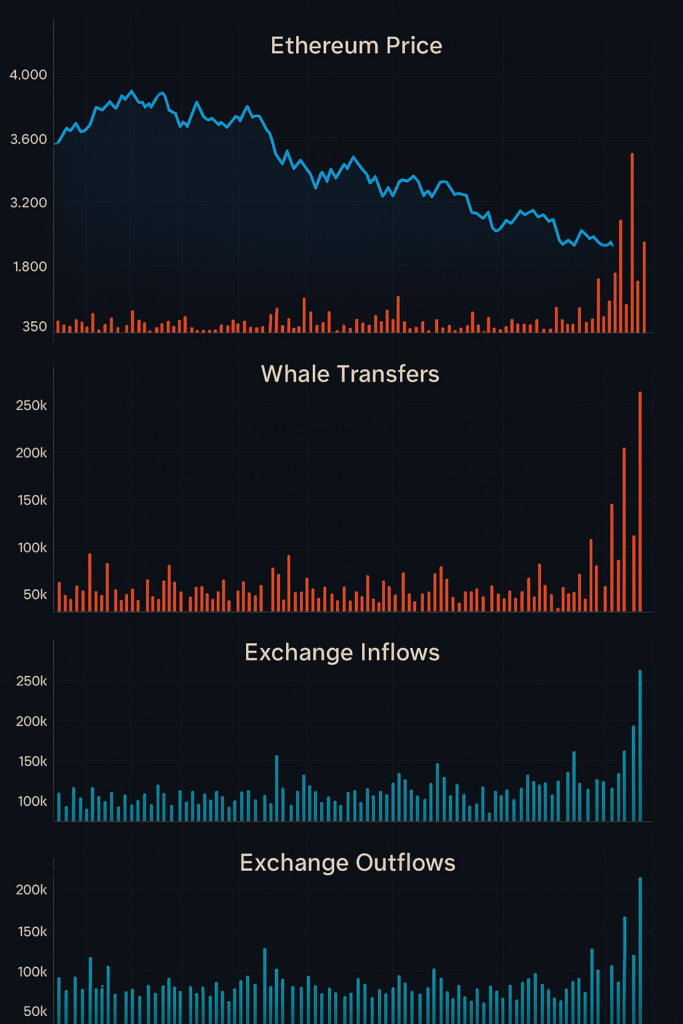
Ethereum (ETH) recently faced a noticeable price dip, but instead of sparking panic, it seems to have awakened major crypto whales. On-chain data reveals that over 540 million ETH was moved by large wallets within a short time frame, raising speculation across the market:
Are whales accumulating for the next rally — or quietly preparing to exit?
The move comes as Ethereum’s price slipped below key support levels, driven by macro uncertainty, lowered DeFi activity, and broader market cooling. However, whale behavior often offers deeper insight into future trends than short-term price movements.
Whale Wallets Make Bold Moves
Blockchain analytics platforms like Lookonchain and Santiment report that top-tier Ethereum wallets have been transferring large sums of ETH to centralized exchanges and cold wallets, triggering mixed reactions. Historically, transfers to exchanges can suggest selling intentions, while transfers to self-custody or staking contracts often imply accumulation or long-term confidence.
Here’s a snapshot of the movements:
- 540 million ETH moved by a cluster of whale wallets
- Significant inflows to both Coinbase and Binance
- Simultaneous outflows to staking platforms and multisig wallets
This contradictory activity is what has analysts divided — some view it as profit-taking, others see it as a strategic accumulation during the dip.
Accumulation Case: Buying the Dip
The “buy-the-dip” narrative is supported by Ethereum’s long-term fundamentals:
- Ethereum’s upcoming scalability upgrades (Danksharding, Proto-Danksharding)
- Persistent institutional interest in ETH-based ETFs
- ETH staking rates continuing to climb despite market volatility
Whales are known for taking contrarian positions, often accumulating when retail sentiment is weak — suggesting that recent activity may reflect strategic accumulation ahead of a potential price recovery.
Exit Case: Risk Management in Uncertain Markets
On the flip side, some analysts warn that whales may be unloading ETH gradually to mitigate downside risk. Recent delays in key protocol upgrades, along with regulatory uncertainty in the U.S. and EU, could prompt whales to hedge their exposure or rotate into stablecoins and other assets.
The presence of large transactions into centralized exchanges is often seen as a signal of intent to sell, though it’s not always definitive.
Conclusion: Accumulation or Exit? The Market Watches Closely
With Ethereum whales moving hundreds of millions worth of ETH during a downturn, the crypto world is on high alert. Whether these large holders are accumulating discounted ETH or cashing out after a long run, one thing is clear:
Whale behavior remains one of the most powerful forces in crypto price dynamics.
Traders and investors should watch exchange inflow/outflow ratios, staking activity, and wallet movement patterns closely in the coming days — because what the whales do next could set the tone for Ethereum’s next major move.