

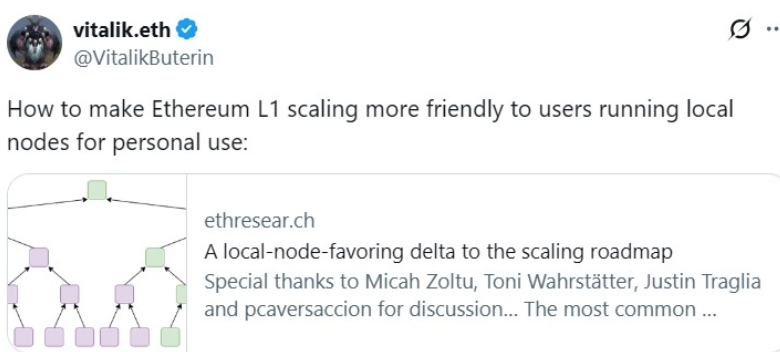
Ethereum co-founder Vitalik Buterin has introduced a new concept to help Ethereum achieve greater scalability: partially stateless nodes. This idea builds on Ethereum’s long-term roadmap to reduce the cost and complexity of running a full node, while maintaining network security and decentralization.
What Are Stateless and Partially Stateless Nodes?
In the Ethereum ecosystem, full nodes currently need to store and manage the entire blockchain state—including all account balances, smart contract data, and storage history. This demands high-end hardware, limiting who can participate.
A fully stateless node doesn’t store any blockchain state and relies entirely on external proofs to verify transactions. While promising, this approach is still years away from practical implementation.
That’s where partially stateless nodes come in—striking a balance between full functionality and lower resource requirements.
With a partially stateless model, nodes can choose not to store certain portions of the state and instead fetch that data only when needed. This lowers the barriers to entry, allowing more people to participate in validating the Ethereum network with less powerful hardware.
Why It Matters for Ethereum’s Future
Ethereum’s vision of decentralization depends on making node operation more accessible. As the network scales through upgrades like Danksharding and EIP-4844 (proto-danksharding), the volume of data processed by nodes will continue to grow.
Buterin believes that reducing node requirements is essential to avoid centralization and reliance on third-party infrastructure providers.
By allowing users to run nodes without storing the full state, Ethereum can increase resilience and broaden participation, especially in regions with limited internet access or expensive computing resources.
Security and Practical Concerns
While promising, the partially stateless approach introduces trade-offs. It may require:
- New mechanisms for securely retrieving and validating state data
- Improvements in proof systems and data availability layers
- Ensuring that latency and performance are not significantly impacted
Ethereum developers are currently discussing how best to implement this idea in future protocol upgrades without compromising on user experience or network security.
A Step Toward a More Inclusive Ethereum
Vitalik’s proposal reflects Ethereum’s ongoing mission to improve scalability, decentralization, and accessibility. While still in early stages, partially stateless nodes could be a crucial bridge to the future of a leaner, more robust Ethereum network.
Ethereum’s future may depend not just on faster transactions—but on empowering more people to help run it.