
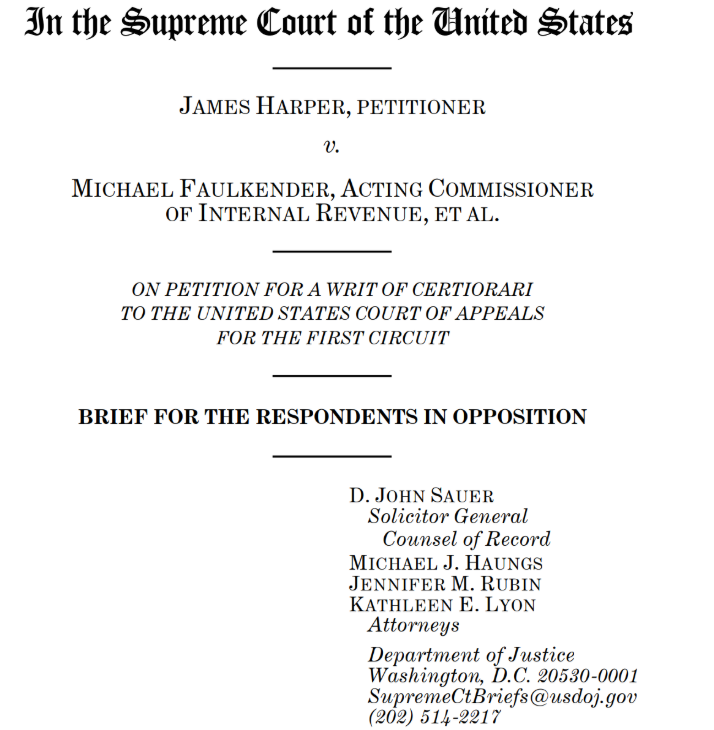
The U.S. government is urging the Supreme Court not to take up a legal challenge by James Harper, a Coinbase user seeking to block the Internal Revenue Service (IRS) from accessing his cryptocurrency transaction history.
In a May 30 court filing, Solicitor General D. John Sauer argued that Harper voluntarily disclosed his information to Coinbase, and therefore, cannot claim constitutional protection under the Fourth Amendment, which guards against unreasonable searches.
“The IRS followed proper legal channels through a court-approved summons,” the government stated, emphasizing that Harper’s financial records do not qualify as private under existing law.
IRS Investigation Traced to 2016 Crypto Tax Gap
Harper’s case stems from a 2016 IRS investigation into widespread tax underreporting linked to cryptocurrency trading. At the time, the IRS noted a large discrepancy between trading activity and tax filings, prompting it to issue a John Doe summons to Coinbase for data on high-volume users.
Harper, who traded Bitcoin on Coinbase during that period, claimed the summons amounted to an unconstitutional search. However, lower courts rejected his argument, stating that records held by Coinbase are business documents, not private communications.
“Coinbase’s records are not protected by the Fourth Amendment,” ruled the First Circuit Court of Appeals.
Supreme Court Precedent Supports the IRS
The government’s filing referenced United States v. Miller, a Supreme Court case establishing that individuals have no reasonable expectation of privacy in financial records held by third-party institutions.
“Coinbase’s privacy policy itself warns users that data may be shared with law enforcement,” the brief noted.
If the Supreme Court declines to hear the case, the lower court’s ruling in favor of the IRS will stand, granting the agency continued access to historical crypto records.
Coinbase Faces Data Breach and Legal Fallout
Separately, Coinbase suffered a major data breach on May 15, where attackers bribed customer support staff in India to access user data, including names, balances, and transaction histories. Approximately 1% of monthly transacting users were affected.
Six lawsuits have since been filed against Coinbase, accusing the exchange of failing to implement adequate security controls and mismanaging its response.
Conclusion
The ongoing case highlights the legal complexities surrounding digital asset privacy and underscores the increasing regulatory scrutiny on crypto exchanges and their data-sharing practices.