

As artificial intelligence (AI) rapidly integrates into financial technologies, its use in the crypto industry is expanding — from trading bots and portfolio management tools to customer service and security systems. However, experts warn that AI agents may introduce an entirely new class of vulnerabilities, and the crypto sector may not be prepared.

AI integration is outpacing security innovation, creating potential blind spots that malicious actors could exploit.


Crypto’s Growing Reliance on AI Agents

Over the past year, crypto platforms and decentralized applications (dApps) have increasingly adopted AI-powered agents to streamline operations. These agents can automate trading, detect fraud, analyze market sentiment, and even interact with smart contracts in real time.

AI agents now make decisions at high speed, sometimes with limited oversight — a setup that opens the door to potential exploits.

Projects like Autonolas, Fetch.ai, and Ocean Protocol are pushing the boundaries of AI autonomy within Web3 ecosystems, but the security frameworks around these systems remain immature.

AI has a trust problem — Decentralized privacy-preserving tech can fix it
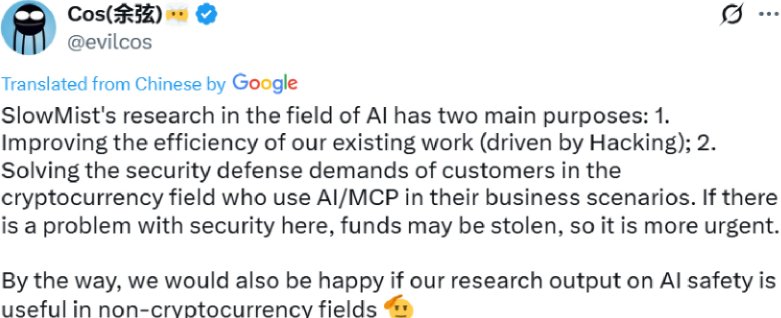

Unseen Vulnerabilities in Complex Systems

AI models, especially large language models (LLMs) and machine learning agents, are often considered black boxes. Unlike traditional smart contracts with transparent codebases, AI agents can behave unpredictably when exposed to adversarial data or edge cases.

An AI trading bot could be manipulated through coordinated false signals or market noise. Worse, it might trigger self-reinforcing losses without realizing it.

Moreover, prompt injection attacks, data poisoning, and model manipulation are now being studied as viable threats — and the crypto industry may become a prime testing ground.


Smart Contracts + AI: A Dangerous Combo?

Combining AI agents with smart contracts increases automation but also compounds risks. If a malicious actor can exploit the AI layer, they may be able to trigger smart contract actions without traditional vulnerabilities being present in the contract code itself.

The fusion of deterministic blockchain systems with non-deterministic AI behavior creates an unpredictable attack surface.

This is particularly concerning in DeFi, where financial logic is immutable and self-executing — meaning a flawed AI-triggered transaction might be irreversible.


Conclusion: Prepare Before It’s Too Late

AI agents bring massive potential to crypto — but they also carry hidden risks the industry is not ready for.

Without rigorous testing, AI-specific security audits, and cross-domain expertise, the next wave of crypto exploits may not come from traditional bugs — but from intelligent systems behaving badly.

The call is clear: the crypto industry must secure its AI layer before the vulnerabilities secure them.

logo

blockto.io

info@blockto.io

Blockto.io Copyright © 2025, All rights reserved

News
Rates
Buy
More
We use cookies to personalize content and ads, provide social media features, and analyze our traffic. In accordance with GDPR/AVG and EU cookie regulations, data is processed only with your consent. We may share information about your use of our website with our social media, advertising, and analytics partners, and you can manage or withdraw your consent at any time. View more
Cookies settings
Accept
Privacy & Cookie policy
Privacy & Cookies policy
Cookie name Active

Privacy Policy

At BitxJournal.com, we respect your privacy and are committed to protecting your personal data. This Privacy Policy explains how we collect, process, store, and protect personal information in accordance with the General Data Protection Regulation (GDPR) and AVG (EU privacy legislation).

1. Data Controller

BitxJournal.com acts as the data controller for all personal data processed through this website.

2. Personal Data We Collect

We may collect and process the following categories of data:

Personal Data

  • Name and email address (when you subscribe to newsletters or contact us)

Technical & Usage Data

  • IP address, browser type, operating system

  • Device information

  • Pages visited, referral sources, and interaction data

This data is collected via cookies, log files, and analytics technologies.

3. Legal Basis for Processing

We process personal data only when a lawful basis exists, including:

  • Consent – when you explicitly agree (e.g., cookies, newsletter sign-up)

  • Legitimate interest – to operate, secure, and improve our website

  • Legal obligation – when required by applicable laws

You may withdraw your consent at any time.

4. Purpose of Data Processing

Your data is processed for the following purposes:

  • Operating and maintaining the website

  • Improving content, usability, and performance

  • Sending newsletters or updates (only with consent)

  • Analyzing traffic and user behavior

  • Responding to inquiries or support requests

5. Cookies & Consent Management

We use cookies and similar technologies in compliance with EU Cookie Law.

  • Non-essential cookies are placed only after explicit user consent

  • Users may accept, reject, or manage cookie preferences at any time

  • Consent can be withdrawn without affecting prior lawful processing

Detailed cookie information is available in our Cookie Settings panel.

6. Third-Party Data Processing

We may share limited data with trusted third-party service providers, including:

  • Analytics providers (e.g., Google Analytics)

  • Advertising partners (for personalized or non-personalized ads)

These third parties act as data processors and process data only under contractual obligations compliant with GDPR/AVG.

7. International Data Transfers

Where data is transferred outside the European Economic Area (EEA), we ensure appropriate safeguards are in place, such as Standard Contractual Clauses (SCCs) or equivalent legal mechanisms.

8. Data Retention

We retain personal data only for as long as necessary to fulfill the purposes outlined in this policy or as required by law.

9. Data Security

We implement appropriate technical and organizational security measures to protect personal data against unauthorized access, alteration, disclosure, or destruction.

10. Your GDPR Rights

Under GDPR/AVG, you have the right to:

  • Access your personal data

  • Rectify inaccurate or incomplete data

  • Request data erasure (“right to be forgotten”)

  • Restrict or object to processing

  • Data portability

  • Withdraw consent at any time

  • Lodge a complaint with a supervisory authority

11. Changes to This Privacy Policy

We reserve the right to update this Privacy Policy at any time. Any changes will be posted on this page with a revised effective date.

12. Contact Information

For privacy-related inquiries or GDPR requests, contact:

📧 Email: support@blockto.io
🌐 Website: https://blockto.io

Save settings
Cookies settings