
A shocking case out of Arizona has revealed the depth of North Korea’s cyber infiltration into the U.S. crypto industry. On Thursday, Christina Marie Chapman was sentenced to 8.5 years in federal prison for her role in helping North Korean IT operatives pose as U.S. workers, defrauding over 300 American companies and raking in $17 million in illicit crypto profits.

How the Crypto Job Scam Worked

According to the U.S. Department of Justice, Chapman worked directly with operatives tied to the Democratic People’s Republic of Korea (DPRK). She supplied stolen identities, fraudulent documents, and U.S.-based IP addresses, enabling North Korean coders to secure remote IT jobs in the U.S.

More than 68 stolen identities were used to infiltrate 309 U.S. firms and two foreign companies.

These workers, posing as Americans, often landed roles at crypto and tech firms, accessing sensitive codebases, customer data, and internal systems.
Legal Fallout and Sentencing

Chapman pleaded guilty in February to wire fraud conspiracy, aggravated identity theft, and money laundering conspiracy. Along with her prison sentence, she must:

  • Forfeit $284,000 in assets tied to the scheme
  • Pay $177,000 in restitution
  • Serve 3 years of supervised release

This marks one of the largest DPRK IT worker schemes ever prosecuted by U.S. authorities.

A Growing Threat to Crypto Security

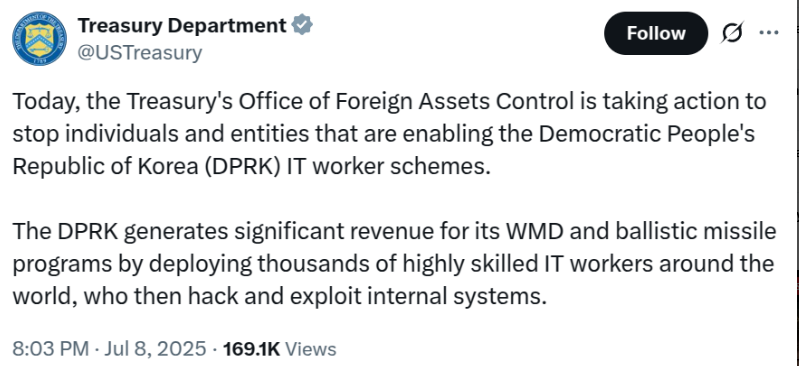
This case isn’t isolated. The Treasury Department recently sanctioned two individuals and four entities linked to similar DPRK-run IT rings. In another instance, four North Koreans infiltrated a U.S. crypto startup and a Serbian blockchain firm, stealing over $900,000.

DPRK hackers fund their nuclear program by stealing from crypto companies, the U.S. Treasury warns.

These schemes frequently rely on fake documents and proxy accounts, allowing DPRK nationals to bypass compliance checks.

Are U.S. Firms at Risk of Sanctions?

Legal experts say yes — even if unintentional. Under OFAC’s strict liability rules, companies hiring sanctioned individuals can face civil or criminal penalties, reputational harm, or even export control violations.

“Even if the developers used fake IDs, companies may still be liable,” warned AMLBot legal head Niko Demchuk.

Conclusion

This case is a wake-up call for crypto firms to upgrade KYC protocols and carefully vet remote hires. Nation-state hackers are evolving — and the U.S. government is cracking down.

Disclaimer

This content is for informational purposes only and does not constitute financial, investment, or legal advice. Cryptocurrency trading involves risk and may result in financial loss.

logo

blockto.io

info@blockto.io

Blockto.io Copyright © 2025, All rights reserved

News
Rates
Buy
More
We use cookies to personalize content and ads, provide social media features, and analyze our traffic. In accordance with GDPR/AVG and EU cookie regulations, data is processed only with your consent. We may share information about your use of our website with our social media, advertising, and analytics partners, and you can manage or withdraw your consent at any time. View more
Cookies settings
Accept
Privacy & Cookie policy
Privacy & Cookies policy
Cookie name Active

Privacy Policy

At BitxJournal.com, we respect your privacy and are committed to protecting your personal data. This Privacy Policy explains how we collect, process, store, and protect personal information in accordance with the General Data Protection Regulation (GDPR) and AVG (EU privacy legislation).

1. Data Controller

BitxJournal.com acts as the data controller for all personal data processed through this website.

2. Personal Data We Collect

We may collect and process the following categories of data:

Personal Data

  • Name and email address (when you subscribe to newsletters or contact us)

Technical & Usage Data

  • IP address, browser type, operating system

  • Device information

  • Pages visited, referral sources, and interaction data

This data is collected via cookies, log files, and analytics technologies.

3. Legal Basis for Processing

We process personal data only when a lawful basis exists, including:

  • Consent – when you explicitly agree (e.g., cookies, newsletter sign-up)

  • Legitimate interest – to operate, secure, and improve our website

  • Legal obligation – when required by applicable laws

You may withdraw your consent at any time.

4. Purpose of Data Processing

Your data is processed for the following purposes:

  • Operating and maintaining the website

  • Improving content, usability, and performance

  • Sending newsletters or updates (only with consent)

  • Analyzing traffic and user behavior

  • Responding to inquiries or support requests

5. Cookies & Consent Management

We use cookies and similar technologies in compliance with EU Cookie Law.

  • Non-essential cookies are placed only after explicit user consent

  • Users may accept, reject, or manage cookie preferences at any time

  • Consent can be withdrawn without affecting prior lawful processing

Detailed cookie information is available in our Cookie Settings panel.

6. Third-Party Data Processing

We may share limited data with trusted third-party service providers, including:

  • Analytics providers (e.g., Google Analytics)

  • Advertising partners (for personalized or non-personalized ads)

These third parties act as data processors and process data only under contractual obligations compliant with GDPR/AVG.

7. International Data Transfers

Where data is transferred outside the European Economic Area (EEA), we ensure appropriate safeguards are in place, such as Standard Contractual Clauses (SCCs) or equivalent legal mechanisms.

8. Data Retention

We retain personal data only for as long as necessary to fulfill the purposes outlined in this policy or as required by law.

9. Data Security

We implement appropriate technical and organizational security measures to protect personal data against unauthorized access, alteration, disclosure, or destruction.

10. Your GDPR Rights

Under GDPR/AVG, you have the right to:

  • Access your personal data

  • Rectify inaccurate or incomplete data

  • Request data erasure (“right to be forgotten”)

  • Restrict or object to processing

  • Data portability

  • Withdraw consent at any time

  • Lodge a complaint with a supervisory authority

11. Changes to This Privacy Policy

We reserve the right to update this Privacy Policy at any time. Any changes will be posted on this page with a revised effective date.

12. Contact Information

For privacy-related inquiries or GDPR requests, contact:

📧 Email: support@blockto.io
🌐 Website: https://blockto.io

Save settings
Cookies settings