

The Bank of England (BoE) is reportedly reassessing its central bank digital currency (CBDC) project amid rising doubts about its effectiveness. According to sources familiar with internal discussions, the UK central bank may cancel its digital pound plans if commercial banks deliver sufficient payment innovation without requiring a state-backed alternative.

Digital Pound Plans Face Resistance

The BoE previously stated in 2023 that a digital pound was “likely needed in the future”, but recent comments suggest a shift. Governor Andrew Bailey told the UK Treasury Committee that he would require “a lot of convincing” to proceed with a CBDC if private payment systems prove successful.

“If that’s a success, I question why we need to introduce a new form of money,” Bailey said.

This statement reflects a broader trend where governments are growing cautious about digital currency experiments, especially when potential benefits remain unproven.
CBDC Privacy and Stability Concerns Grow

More than 50,000 public responses, mostly critical, were submitted during a recent consultation phase. Key concerns include:

  • Potential invasion of privacy through transaction tracking
  • Destabilizing effects during financial crises, such as bank runs
  • Dominance of foreign stablecoins or Big Tech tokens over the British pound

These issues have attracted criticism from lawmakers and suspicion from privacy advocacy groups, intensifying scrutiny of the project.

UK CBDC Development Lags Behind Global Peers

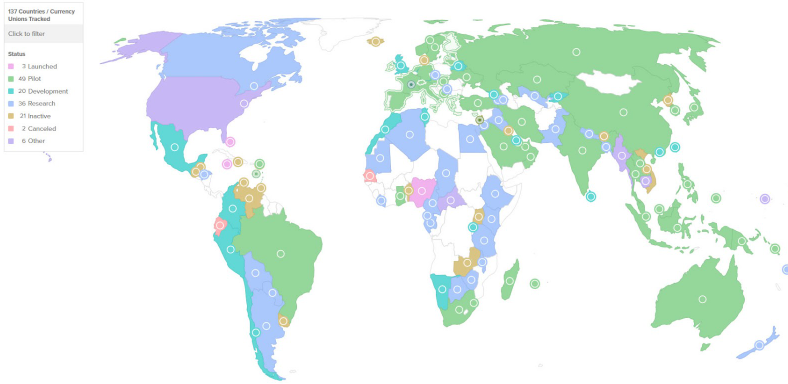
The Atlantic Council’s CBDC tracker indicates that the UK remains in the early development phase, well behind other regions. Currently:

  • Only 3 countries (Bahamas, Jamaica, Nigeria) have launched CBDCs
  • 49 countries are in pilot testing
  • 20 countries are actively developing
  • 36 countries remain in research mode

Despite global momentum, CBDC adoption remains slow, with governments weighing risks versus innovation opportunities.

US Legislative Push Against CBDCs

The United States recently passed the Anti-CBDC Surveillance State Act, which blocks the Federal Reserve from launching or testing any CBDC without explicit Congressional approval. This follows rising fears that government-backed digital currencies could enable mass surveillance and erode financial freedom.

Final Decision Still Pending

While no final decision has been announced, the UK’s central bank appears more inclined to support private-sector-led payment solutions. With mounting public and political resistance, the future of the digital pound remains uncertain.

This development signals a global slowdown in government-backed digital currency rollouts, as central banks rethink their roles in an evolving financial ecosystem.

Disclaimer

This content is for informational purposes only and does not constitute financial, investment, or legal advice. Cryptocurrency trading involves risk and may result in financial loss.

logo

blockto.io

info@blockto.io

Blockto.io Copyright © 2025, All rights reserved

News
Rates
Buy
More
We use cookies to personalize content and ads, provide social media features, and analyze our traffic. In accordance with GDPR/AVG and EU cookie regulations, data is processed only with your consent. We may share information about your use of our website with our social media, advertising, and analytics partners, and you can manage or withdraw your consent at any time. View more
Cookies settings
Accept
Privacy & Cookie policy
Privacy & Cookies policy
Cookie name Active

Privacy Policy

At BitxJournal.com, we respect your privacy and are committed to protecting your personal data. This Privacy Policy explains how we collect, process, store, and protect personal information in accordance with the General Data Protection Regulation (GDPR) and AVG (EU privacy legislation).

1. Data Controller

BitxJournal.com acts as the data controller for all personal data processed through this website.

2. Personal Data We Collect

We may collect and process the following categories of data:

Personal Data

  • Name and email address (when you subscribe to newsletters or contact us)

Technical & Usage Data

  • IP address, browser type, operating system

  • Device information

  • Pages visited, referral sources, and interaction data

This data is collected via cookies, log files, and analytics technologies.

3. Legal Basis for Processing

We process personal data only when a lawful basis exists, including:

  • Consent – when you explicitly agree (e.g., cookies, newsletter sign-up)

  • Legitimate interest – to operate, secure, and improve our website

  • Legal obligation – when required by applicable laws

You may withdraw your consent at any time.

4. Purpose of Data Processing

Your data is processed for the following purposes:

  • Operating and maintaining the website

  • Improving content, usability, and performance

  • Sending newsletters or updates (only with consent)

  • Analyzing traffic and user behavior

  • Responding to inquiries or support requests

5. Cookies & Consent Management

We use cookies and similar technologies in compliance with EU Cookie Law.

  • Non-essential cookies are placed only after explicit user consent

  • Users may accept, reject, or manage cookie preferences at any time

  • Consent can be withdrawn without affecting prior lawful processing

Detailed cookie information is available in our Cookie Settings panel.

6. Third-Party Data Processing

We may share limited data with trusted third-party service providers, including:

  • Analytics providers (e.g., Google Analytics)

  • Advertising partners (for personalized or non-personalized ads)

These third parties act as data processors and process data only under contractual obligations compliant with GDPR/AVG.

7. International Data Transfers

Where data is transferred outside the European Economic Area (EEA), we ensure appropriate safeguards are in place, such as Standard Contractual Clauses (SCCs) or equivalent legal mechanisms.

8. Data Retention

We retain personal data only for as long as necessary to fulfill the purposes outlined in this policy or as required by law.

9. Data Security

We implement appropriate technical and organizational security measures to protect personal data against unauthorized access, alteration, disclosure, or destruction.

10. Your GDPR Rights

Under GDPR/AVG, you have the right to:

  • Access your personal data

  • Rectify inaccurate or incomplete data

  • Request data erasure (“right to be forgotten”)

  • Restrict or object to processing

  • Data portability

  • Withdraw consent at any time

  • Lodge a complaint with a supervisory authority

11. Changes to This Privacy Policy

We reserve the right to update this Privacy Policy at any time. Any changes will be posted on this page with a revised effective date.

12. Contact Information

For privacy-related inquiries or GDPR requests, contact:

📧 Email: support@blockto.io
🌐 Website: https://blockto.io

Save settings
Cookies settings