

Potential changes to global bank capital standards could open the door for greater institutional participation in Bitcoin, according to market analysts monitoring regulatory developments. The updates are expected as part of revisions to the Basel III framework scheduled for implementation in 2026.
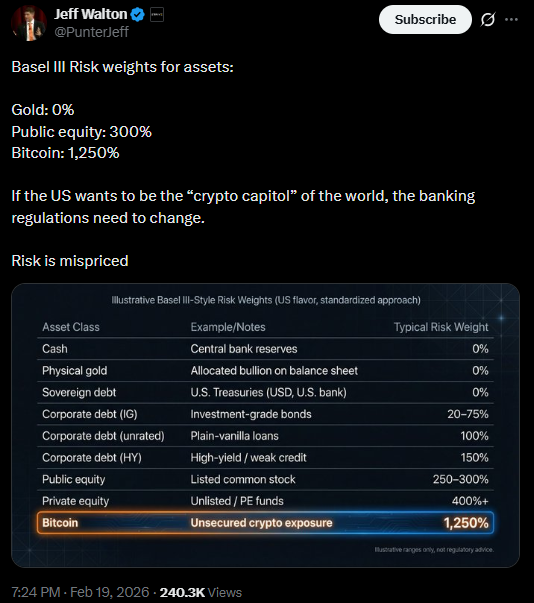
Currently, the Basel capital rules assign Bitcoin and similar digital assets a 1,250% risk weight. This classification requires banks to hold reserve capital equal to the full value of any Bitcoin exposure on their balance sheets. Analysts say such requirements make it extremely costly for banks to hold BTC directly or offer related services.
Possible Impact of Lower Risk Weight
If regulators reduce Bitcoin’s risk weighting even slightly, it could allow banks to allocate capital more efficiently and potentially bring significant new liquidity into the market. Banks typically direct capital toward assets with lower regulatory costs, meaning any adjustment could encourage broader participation in the crypto sector.
Debate Over Crypto Risk Classification
Under the current framework proposed by the Basel Committee on Banking Supervision, cryptocurrencies are placed in the highest risk category. By comparison, investment-grade corporate bonds may carry risk weights of up to 75%, while assets such as gold and government bonds have a 0% risk weight.
Risk weights for different asset classes under the Basel III framework: Jeff Walton;
Some industry executives argue the existing classification discourages banks from engaging with digital assets and limits the sector’s integration with traditional finance.
Disclaimer
This content is for informational purposes only and does not constitute financial, investment, or legal advice. Cryptocurrency trading involves risk and may result in financial loss.