

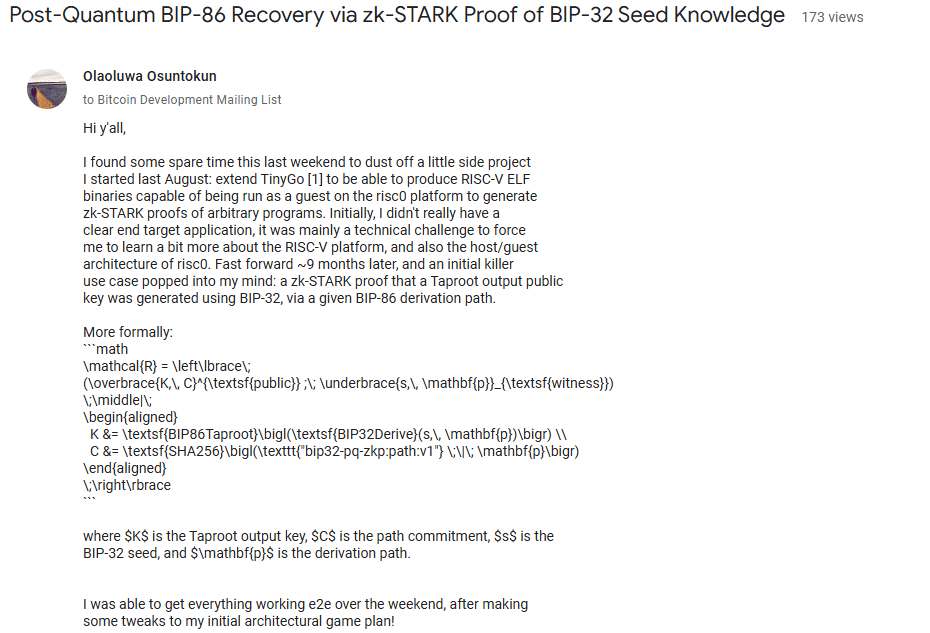
Lightning Labs CTO Olaoluwa “Roasbeef” Osuntokun has unveiled a working prototype designed to protect Bitcoin wallets from potential quantum attacks. The tool enables users of vulnerable Taproot and other modern wallets to prove wallet ownership using their secret seed without revealing it, providing a backup method if the network disables traditional digital signatures.
Bitcoin currently relies on cryptographic signatures, which a sufficiently powerful quantum computer could forge. To counter this, developers have proposed BIP-360, a quantum resistant wallet migration plan, and an “emergency brake” upgrade that would shut off Bitcoin’s signature system. While the emergency brake could prevent theft, it risks locking millions of users out of wallets dependent solely on Taproot signatures.
Osuntokun’s prototype acts as an escape hatch. It allows users to mathematically prove they created a wallet, securing funds even if signatures are disabled. Proof generation on a high-end MacBook takes about 55 seconds, verification under two seconds, and the resulting file is roughly 1.7 MB.
Currently, there is no formal adoption path, and developers remain divided on the urgency of quantum threats. Analysts note that while large-scale quantum attacks remain theoretical, exposed wallets are at risk. The prototype offers a practical solution to prevent collateral loss without compromising other wallets, addressing a long-standing gap in Bitcoin’s quantum contingency planning.
Disclaimer
This content is for informational purposes only and does not constitute financial, investment, or legal advice. Cryptocurrency trading involves risk and may result in financial loss.