

Bitcoin has erased its early 2026 gains after a sharp sell-off that triggered $1.8 billion in liquidations within 48 hours. The downturn pushed Bitcoin below $88,000, while the broader crypto market saw a steep contraction, highlighting renewed sensitivity to global macroeconomic stress.
Bitcoin fell nearly 4% in a single session, reaching around $87,790, its lowest level since late December. Over the past week, the asset is down approximately 10%, wiping out all gains accumulated earlier this year. Notably, Bitcoin slipped below its 50-day exponential moving average, a technical level that previously supported its upward momentum.
Across crypto markets, total capitalization declined by $225 billion, dropping to roughly $3.08 trillion, marking the largest market drawdown since mid-November.
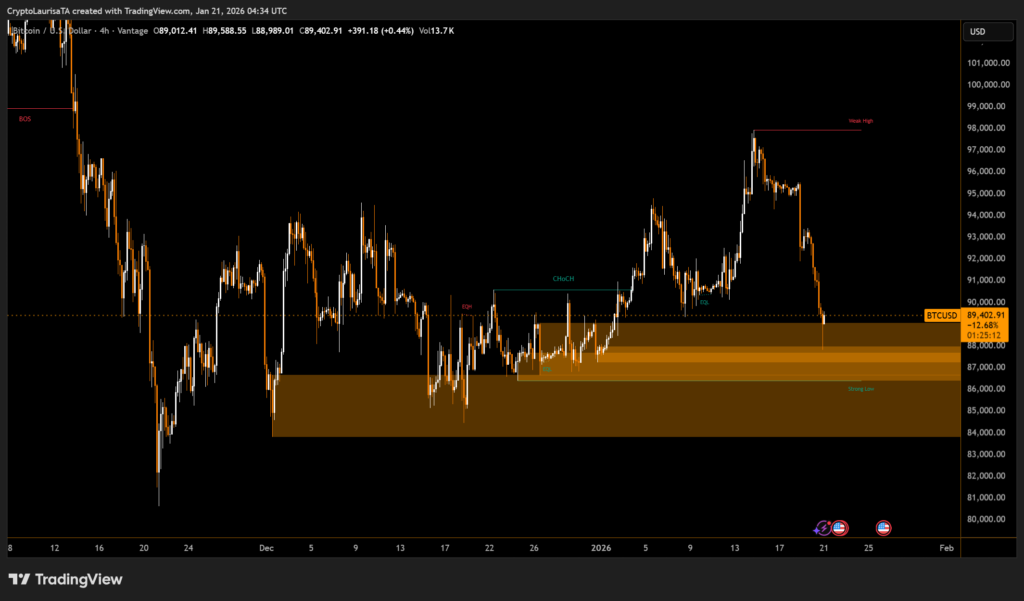
Data from derivatives markets shows that around 93% of liquidated positions were longs, underscoring how leveraged bullish bets were aggressively unwound. This rapid deleveraging amplified downside pressure and accelerated price declines across major digital assets.
Analysts linked the volatility to a resurgence of the “sell America” trade, fueled by renewed U.S. tariff threats. At the same time, turmoil in the Japanese government bond market added stress to global liquidity. Japanese 10-year bond yields surged sharply, while long-term yields recorded their largest daily jump in decades, raising concerns about tighter financial conditions.
Market observers noted that the bond market shock could accelerate carry trade unwinds, reducing global liquidity. While Bitcoin is often compared to hard assets like gold, its high sensitivity to liquidity shifts has left it vulnerable during periods of macro-driven risk aversion.
The recent sell-off highlights how macro uncertainty and leverage dynamics continue to shape Bitcoin’s short-term performance, even as long-term adoption narratives remain intact.
Disclaimer
This content is for informational purposes only and does not constitute financial, investment, or legal advice. Cryptocurrency trading involves risk and may result in financial loss.