

Lower volatility could benefit large investors but dampen retail excitement
Bitcoin’s latest market cycle is showing signs of maturity as institutional investors ramp up their presence, according to remarks from MicroStrategy executive chairman Michael Saylor. While this shift could strengthen the digital asset’s long-term appeal, it may also reduce the thrill that has historically attracted retail traders.
Speaking in a recent interview, Saylor explained that a decline in volatility is necessary for mega institutions to feel confident about allocating capital at scale. He described this shift as both a natural and positive part of Bitcoin’s evolution, even though it could temporarily disappoint short-term speculators.
“You want the volatility to decrease so the mega institutions feel comfortable entering the space and size,” Saylor said. “The conundrum is, if the volatility decreases, it is going to be boring for a while, and because it’s boring, people’s adrenaline rush is going to drop.”
Saylor framed this stage as a “growing phase” for Bitcoin, stressing that reduced volatility is not a weakness but rather a sign of maturity.
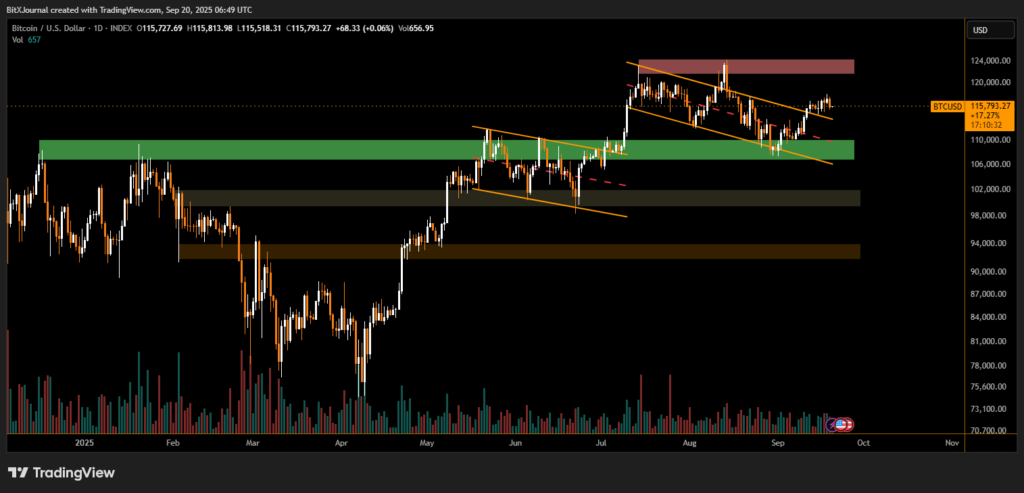
Market pause after record highs
Bitcoin hit an all-time high of $124,100 on Aug. 14 but has since stabilized near $115,760, showing little movement compared to its $114,618 level on Aug. 21. Despite the pause, Bitcoin remains up more than 81% year-on-year, highlighting strong overall momentum.
Some analysts attribute the current sideways trading to expectations around U.S. Federal Reserve policy. While the recent September 17 interest rate cut may already be priced in, additional cuts later this year could provide a fresh boost to crypto markets.
Diverging price forecasts
Market experts remain divided on Bitcoin’s trajectory. BitMEX co-founder Arthur Hayes projects a run toward $250,000 by year-end, while others suggest a more modest climb toward $150,000. On the other hand, some analysts warn of the possibility of a 70% drawdown from future highs.
Saylor emphasized that Bitcoin remains in the early stages of innovation, predicting that the 2025–2035 period will resemble a digital gold rush filled with new products, business models, and inevitable growing pains.
Currently, publicly listed companies hold nearly $118 billion in Bitcoin, underscoring the expanding institutional footprint that is gradually reshaping the asset’s identity.
Disclaimer
This content is for informational purposes only and does not constitute financial, investment, or legal advice. Cryptocurrency trading involves risk and may result in financial loss.