

Bitcoin has fallen sharply below the $70,000 level, erasing gains built over the past 15 months and triggering renewed concern about deeper downside risks. The move marks the first time since November 2024 that Bitcoin has traded below the previous 2021 bull market high, signaling a clear shift in market momentum.
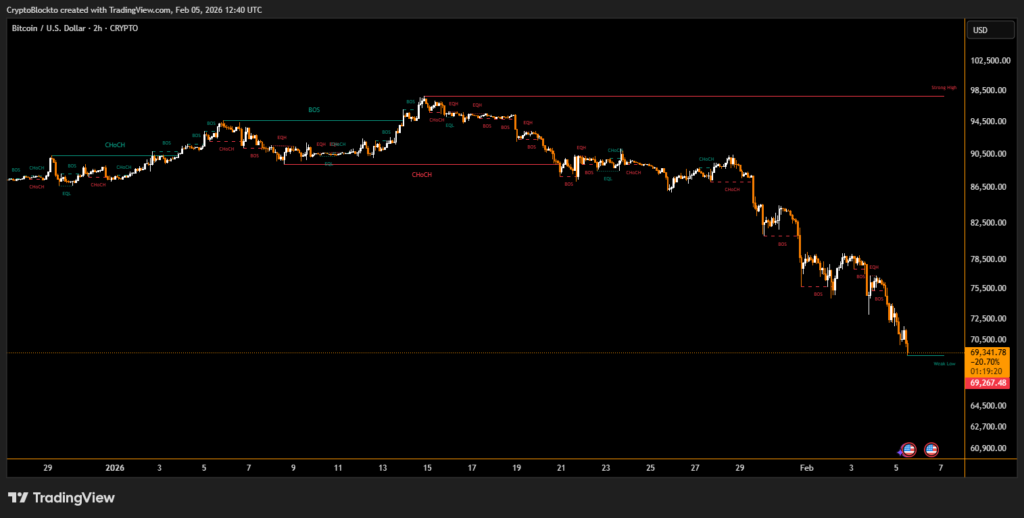
During the Asia trading session, Bitcoin slid to around $69,100, entering the $60,000 range for the first time in months. The decline triggered roughly $130 million in long liquidations within just a few hours, highlighting how leveraged positions amplified the sell-off. Traders are now closely watching the $69,000 zone, which sits just above the long-term 200-week exponential moving average, a level often viewed as critical structural support.
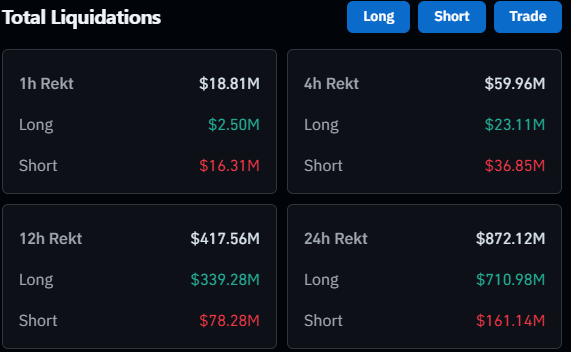
According to CoinGlass data, In the past 24 hours, 176k traders were liquidated, the total liquidations comes in at $872.6 million.
Whale Selling and Scheduled Distribution Pressure
Market participants point to large-scale, coordinated selling as a primary driver of the downturn. Several traders suggest that major holders are offloading Bitcoin according to a fixed schedule, possibly through over-the-counter channels, which steadily feeds supply into the market without regard for short-term price action. This behavior has led some analysts to compare current conditions to past government-led Bitcoin distributions.
Macro Volatility and Weak U.S. Demand
Bitcoin’s weakness has coincided with sharp swings in gold and silver prices, reinforcing the view that broader macro volatility is influencing risk assets. At the same time, indicators tracking U.S.-based demand show persistent weakness, with pricing discrepancies suggesting ongoing selling pressure. Until those signals reverse, traders warn that lower price targets, including the $50,000 region, remain possible.
Disclaimer
This content is for informational purposes only and does not constitute financial, investment, or legal advice. Cryptocurrency trading involves risk and may result in financial loss.