

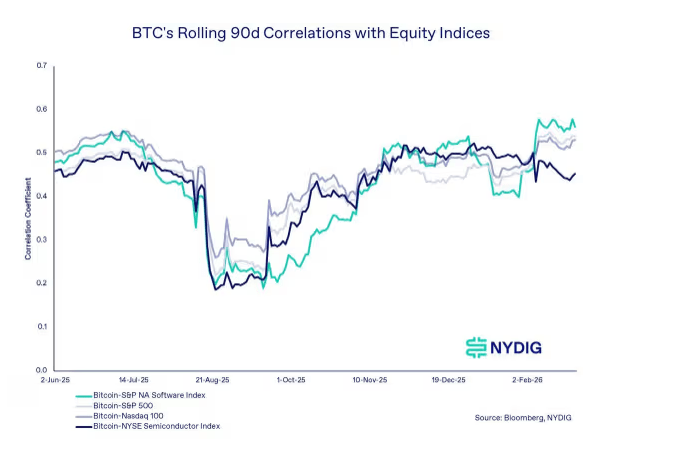
Recent data shows that Bitcoin has moved more closely with major stock indexes in recent months, but analysts say the crypto still plays an important role in portfolio diversification. According to research from NYDIG, Bitcoin’s correlation with equity benchmarks has risen to around 0.5.
The correlation includes major indexes such as the S&P 500 and the Nasdaq-100. However, analysts say that even with correlations at this level, stocks explain only about 25% of Bitcoin’s price movements, leaving the majority of price changes driven by crypto-specific factors.
Unique Market Forces Continue to Influence Bitcoin
Analysts note that Bitcoin’s performance is influenced by a range of factors outside traditional equity markets. These include capital inflows into Bitcoin investment funds, changes in derivatives market positioning, adoption of the network, and regulatory developments.
The recent alignment with growth stocks is widely seen as a reflection of the broader macroeconomic environment rather than a permanent shift. Both Bitcoin and technology equities tend to react to liquidity conditions and investor appetite for risk, which can temporarily move their prices in similar directions.
Debate Shifts Toward Bitcoin as a Reserve Asset
As Bitcoin matures, the discussion around the asset is evolving. Early debates focused on whether Bitcoin could survive long term. Today, analysts and investors increasingly question whether it could eventually function as a sovereign reserve asset.
Prominent investors including Ray Dalio have raised concerns about volatility, regulation and future technological risks. Despite these criticisms, analysts argue that Bitcoin’s long-term value is rooted in its globally distributed network, digital scarcity and political neutrality, rather than central bank adoption alone.
Disclaimer
This content is for informational purposes only and does not constitute financial, investment, or legal advice. Cryptocurrency trading involves risk and may result in financial loss.