

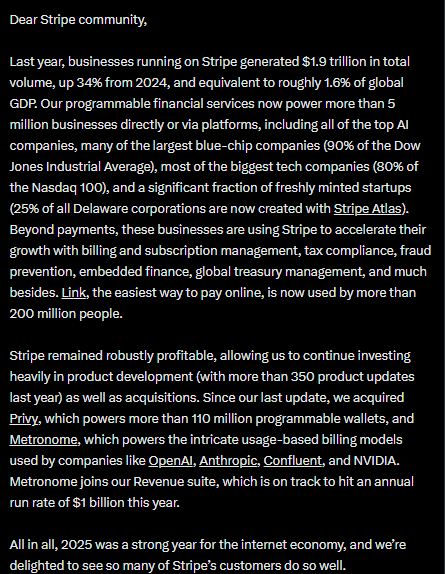
Global payments firm Stripe has signaled that blockchain infrastructure may need to scale dramatically to support the rise of artificial intelligence agents. In its latest annual outlook, co founders Patrick Collison and John Collison projected that decentralized networks could eventually require throughput exceeding one million and potentially one billion transactions per second (TPS).
AI Agents and Rising Transaction Demand
Stripe executives argue that AI agents are likely to become primary actors in online commerce, autonomously conducting payments, executing contracts, and interacting with digital services. As adoption accelerates, transaction volumes across blockchain networks are expected to surge.
They pointed to past congestion events as a warning sign. During a recent memecoin trading surge on a major blockchain, transaction fees spiked 35 times higher than usual and delayed certain payouts by over 12 hours. Such bottlenecks, they suggest, could become more frequent without significant infrastructure upgrades.
Current Blockchain Throughput Limits
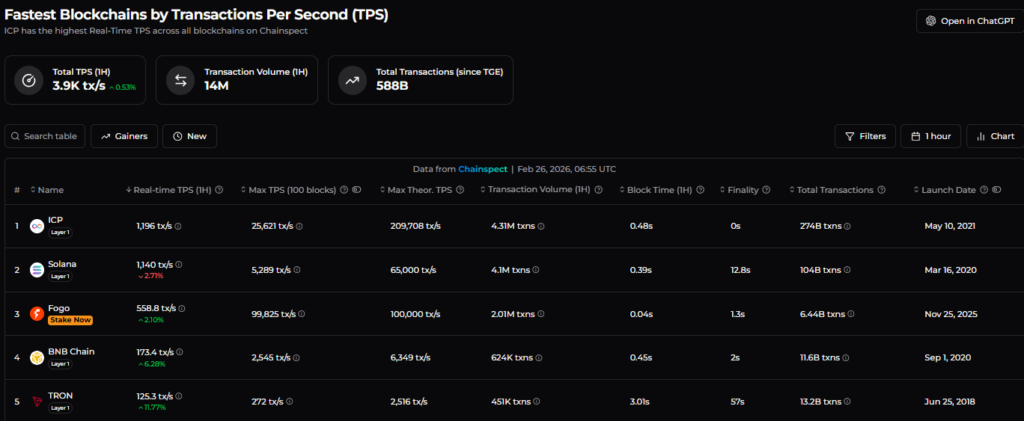
According to performance data, Internet Computer and Solana currently lead in live transaction speeds, processing roughly 1,196 TPS and 1,140 TPS respectively. At peak capacity, they have reached 25,621 TPS and 5,289 TPS. However, their theoretical maximum limits 209,708 TPS for Internet Computer and 65,000 TPS for Solana remain far below the billion TPS threshold envisioned for a fully AI-driven digital economy.
Stripe maintains that AI commerce has moved beyond early hype, entering a phase of real-world experimentation with practical use cases emerging.
Disclaimer
This content is for informational purposes only and does not constitute financial, investment, or legal advice. Cryptocurrency trading involves risk and may result in financial loss.