

The global debate over who should control and guarantee money resurfaced at the World Economic Forum in Davos, where central bankers and crypto leaders confronted a fundamental question: does trust in money come from institutions or from decentralized technology? The discussion highlighted growing tensions between traditional monetary authorities and the rise of Bitcoin as an alternative financial system.
French central bank governor François Villeroy de Galhau argued that trust in money must be anchored in regulated public institutions. According to his view, independent central banks with democratic mandates provide stability, accountability, and long-term confidence. He emphasized that regulation is not a barrier but rather a foundation for financial trust, especially as new technologies like tokenization reshape payments. Galhau also reiterated that central bank digital currencies, such as the digital euro, are designed to modernize payment systems while preserving monetary sovereignty, not to replace private banks.
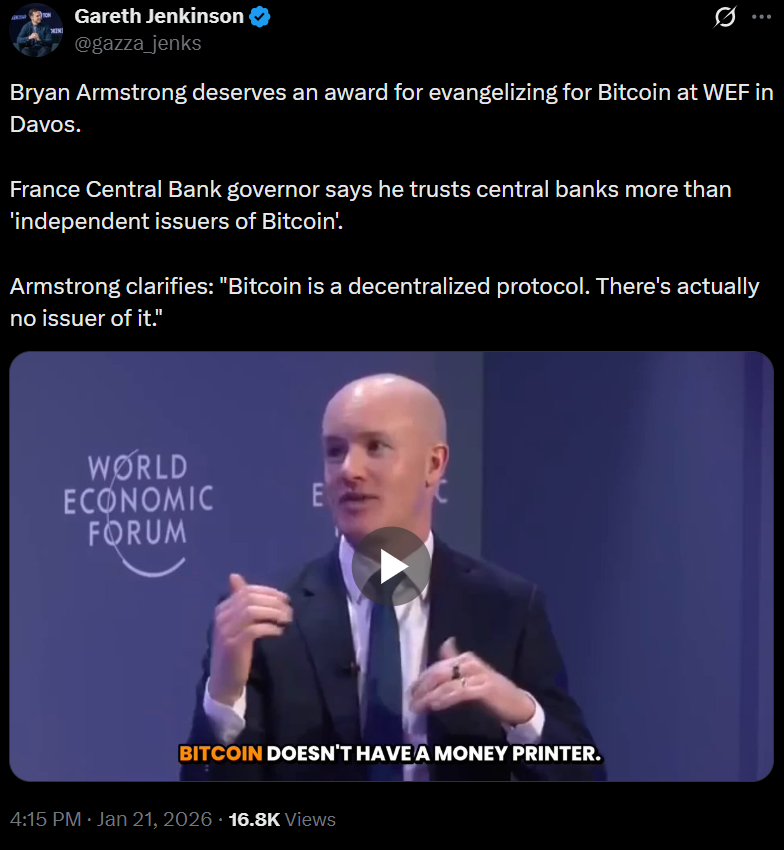
Coinbase CEO Brian Armstrong challenged this perspective by pointing out that Bitcoin operates without a central issuer. He argued that Bitcoin’s decentralization makes it uniquely independent, as no government, company, or individual controls it. From this angle, trust emerges from open code, global participation, and user choice rather than institutional authority.
Rather than framing the issue as a zero-sum battle, Armstrong suggested healthy competition between Bitcoin and central banks. Allowing people to choose which system they trust most could act as a powerful accountability mechanism, particularly around government spending and monetary discipline.
The Davos exchange underscored a shifting financial landscape where institutional trust and technological trust increasingly coexist. As digital finance evolves, the ultimate judge of credibility may not be policymakers or protocols alone, but the public itself.
Disclaimer
This content is for informational purposes only and does not constitute financial, investment, or legal advice. Cryptocurrency trading involves risk and may result in financial loss.