

Low-cost electricity, rising rig demand, and softer policy signals revive underground mining activity across key Chinese provinces
China has re-emerged as a major force in global Bitcoin mining, reclaiming an estimated 14% share of worldwide hashrate despite a nationwide ban implemented in 2021. Fresh data and industry interviews indicate a strong resurgence driven by cheap power, excess data center capacity, and a subtle shift in policy tone. The revival has significant implications for mining economics, global competition, and regulatory oversight.
China’s Mining Activity Surges Back Underground
New estimates from industry trackers show China rising back to the third-largest mining hub, reversing years of near-absence after the 2021 crackdown.
Miners told reporters that regions such as Xinjiang and Sichuan now host expanding underground operations supported by surplus electricity and rapid infrastructure build-out.
One Asia-based mining consultant noted that “low-cost power remains China’s competitive advantage, and operators are taking advantage of excess capacity wherever enforcement is lighter.”
Rising domestic sales of mining rigs further confirm the trend. Manufacturers such as Canaan have seen a sharp rebound in Chinese demand, driven partly by stronger Bitcoin prices and uncertainty around U.S. trade policies that slowed overseas orders.
Data from major analytics firms suggests that 15–20% of global mining capacity may now be located in China — significantly higher than previously assumed.
Policy Signals Suggest a Softer Stance
While China has not explicitly reversed its ban, experts point to regulatory signals that reflect a more flexible attitude toward digital assets.
Hong Kong’s advancement of stablecoin legislation and discussions about yuan-linked stablecoins have been interpreted as early signs of a potential shift.
A digital-asset policy researcher commented that “recent developments suggest a willingness to explore controlled crypto frameworks, even if mainland policy remains officially restrictive.”
Bitcoin Hashprice Hits Record Low
The mining rebound comes as Bitcoin hashprice — a key metric representing miner revenue per unit of computing power — fell to an all-time low of $34.2 per PH/s.
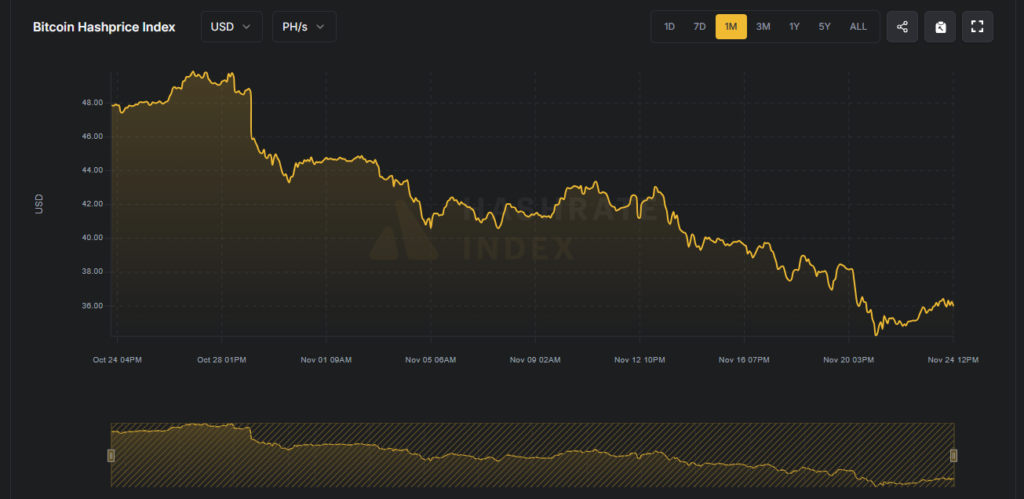
This decline is driven by a combination of weaker Bitcoin prices, reduced transaction fees, and persistently high network difficulty, tightening margins for miners worldwide.
Hashprice fluctuates based on four factors: Bitcoin price, network difficulty, block rewards, and fee volume. With Bitcoin down over 30% since its October peak and network hashrate hovering just above one zettahash, miner profitability remains under pressure.
China’s quiet return to the global mining stage highlights the resilience of underground operations and the continued appeal of inexpensive power regions.
As hashprice declines and global competition intensifies, the renewed activity may reshape mining geography once again — especially if China’s evolving policy signals lead to more explicit regulatory adjustments in the future.
Disclaimer
This content is for informational purposes only and does not constitute financial, investment, or legal advice. Cryptocurrency trading involves risk and may result in financial loss.