

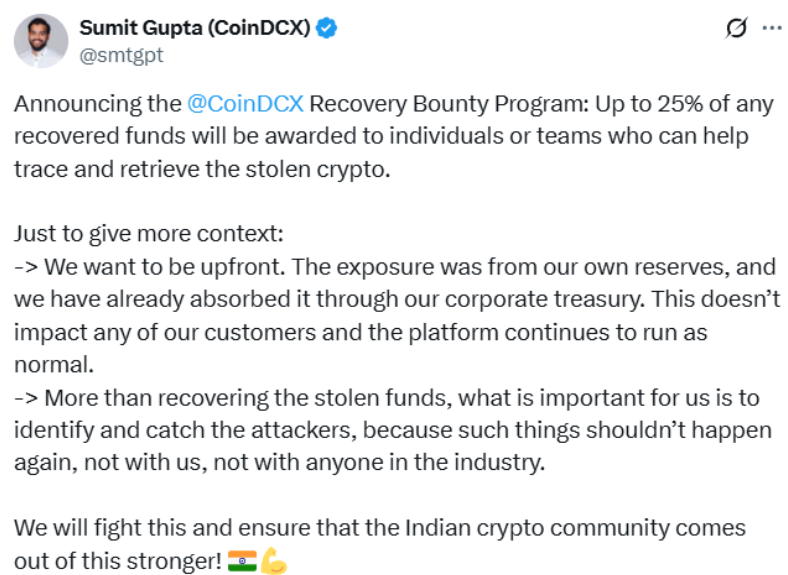
India’s top crypto exchange, CoinDCX, has announced a white hat recovery bounty program after suffering a $44 million exploit last Friday. The exchange has pledged up to 25% of recovered funds as a reward for ethical hackers who help trace and retrieve the stolen assets.
What Happened in the CoinDCX Hack?
According to CEO Sumit Gupta, the breach targeted CoinDCX’s internal liquidity provision accounts, not user wallets. The stolen funds came from the company’s corporate reserves, which have already absorbed the loss. “Our users remain fully protected, and platform operations continue as normal,” Gupta assured in a public statement.
The recovery bounty incentivizes ethical hackers to track the attackers and recover assets—marking a proactive step in exchange accountability.
A Pattern of Centralized Exchange Vulnerabilities
The CoinDCX hack follows a troubling trend. In 2024, WazirX, another Indian crypto platform, lost over $230 million in an attack. Earlier in 2025, Bybit suffered a staggering $1.4 billion exploit, the largest in crypto history.
Michael Pearl, VP at blockchain security firm Cyvers, noted that over 65% of Q2 2024 losses in Web3 originated from centralized exchange (CEX) incidents. These included wallet access breaches and internal vulnerabilities, exposing systemic weaknesses in custodial platforms.
Security Experts Urge Real-Time Monitoring
Pearl emphasized that the CoinDCX hack is “not an isolated event, but part of a larger, preventable pattern.” Cyvers advocates for preemptive cybersecurity tools, like offchain transaction validation and real-time wallet monitoring, which could prevent up to 99% of crypto hacks and scams.
A Wake-Up Call for Centralized Crypto Platforms
While CoinDCX acted swiftly and transparently, the attack highlights the urgent need for stronger access controls and proactive security protocols. With increasing scrutiny on CeFi platforms, exchanges must evolve their security posture to stay ahead of sophisticated threats.
Disclaimer
This content is for informational purposes only and does not constitute financial, investment, or legal advice. Cryptocurrency trading involves risk and may result in financial loss.