
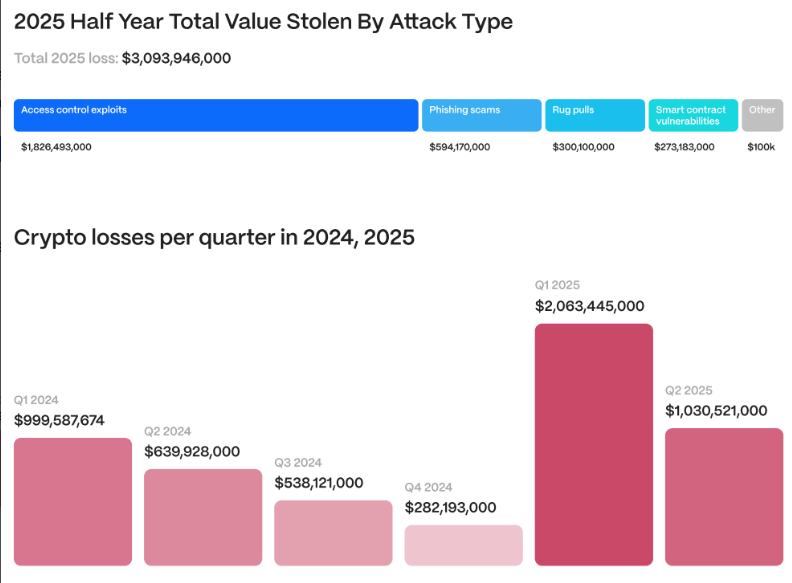
Over $3.1 billion in crypto assets have been stolen in 2025, already surpassing the full-year total of 2024, according to the Hacken 2025 Half-Year Web3 Security Report. Despite growing security awareness, access-control vulnerabilities remain the top cause, highlighting deep-rooted flaws in crypto’s infrastructure.
Access-Control Flaws Dominate Losses
Access-control exploits accounted for 59% of total losses, while smart contract bugs contributed around 8%, or $263 million. One major incident was the $1.5 billion Bybit hack, which skewed Q1’s numbers but didn’t change the overall trend: crypto platforms remain vulnerable at the operational level.
“Projects must care for their old codebases if they haven’t shut them down completely,” said Yehor Rudytsia, Head of Forensics at Hacken.
Outdated systems like GMX V1 were particularly targeted, suggesting that legacy code poses an increasing threat.
Cetus Hack Marks DeFi’s Worst Quarter Since 2023
DeFi platforms took a major hit in Q2 with the $223 million Cetus hack, where a flash loan exploit allowed the attacker to drain 264 liquidity pools in just 15 minutes. The vulnerability stemmed from a missing overflow check in its pricing logic.
Hacken’s report states that 90% of funds could have been saved if the protocol had deployed real-time TVL monitoring with auto-pause—a stark reminder of the need for proactive threat response systems.
AI Expands Attack Surface
The report also warns that AI-driven risks are rising fast:
- AI-related attacks are up 1,025% from 2023.
- 98.9% of these stem from insecure APIs.
- 34% of Web3 projects now run AI agents in production, making them new targets.
Existing cybersecurity frameworks like ISO/IEC 27001 and NIST CSF fail to fully address AI-specific risks such as model hallucination, prompt injection, and data poisoning, urging a need for updated protocols.
Outlook
2025 is on pace to be the worst year in crypto security history. As exploits shift from code to human and process-level weaknesses, developers must prioritize access controls, secure legacy systems, and adapt cybersecurity frameworks to the realities of AI-integrated platforms.
Crypto’s growth depends not just on innovation—but on accountability.
Disclaimer
This content is for informational purposes only and does not constitute financial, investment, or legal advice. Cryptocurrency trading involves risk and may result in financial loss.