

Shipping companies considering crypto payments to Iranian authorities for transit access may face serious legal and financial consequences under existing sanctions rules. Analysts warn that payments tied to strategic waterways or logistics services could be interpreted as material support to sanctioned entities, particularly those linked to Iran’s security infrastructure.
Under current international restrictions, transactions involving Iranian state-linked organizations may trigger enforcement actions across multiple jurisdictions. This risk is heightened by the possibility that entities associated with maritime control, including military-linked groups, remain subject to strict sanctions frameworks.
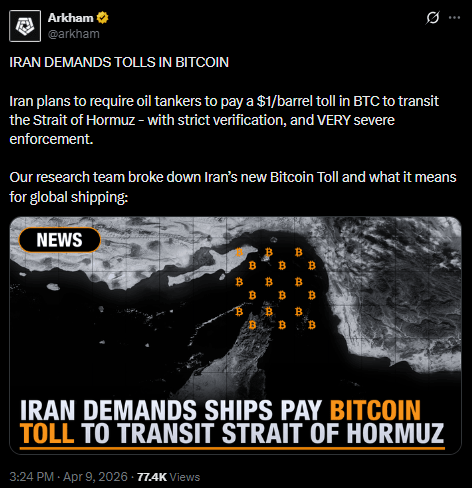
Blockchain Transparency Makes Transactions Easier to Trace
While cryptocurrency is often viewed as a tool for bypassing traditional banking systems, experts stress that blockchain transactions are not anonymous. Digital asset transfers leave permanent public records that investigators can analyze to identify payment trails.
Authorities can track funds through wallet activity and monitor movement toward exchanges or service providers where assets may ultimately be converted into cash. At these conversion points, funds can potentially be frozen or seized, making crypto less effective for sanctions avoidance than commonly assumed.
Iran Expands Crypto Use Amid Regional Pressure
Recent data indicates that Iran’s Bitcoin mining output has dropped sharply, falling by roughly 7 exahashes per second to around 2 EH/s during the past quarter. Despite this decline, the global Bitcoin network remains stable, with overall hashrate holding near 1,000 EH/s, suggesting the disruption has remained largely localized.
Disclaimer
This content is for informational purposes only and does not constitute financial, investment, or legal advice. Cryptocurrency trading involves risk and may result in financial loss