
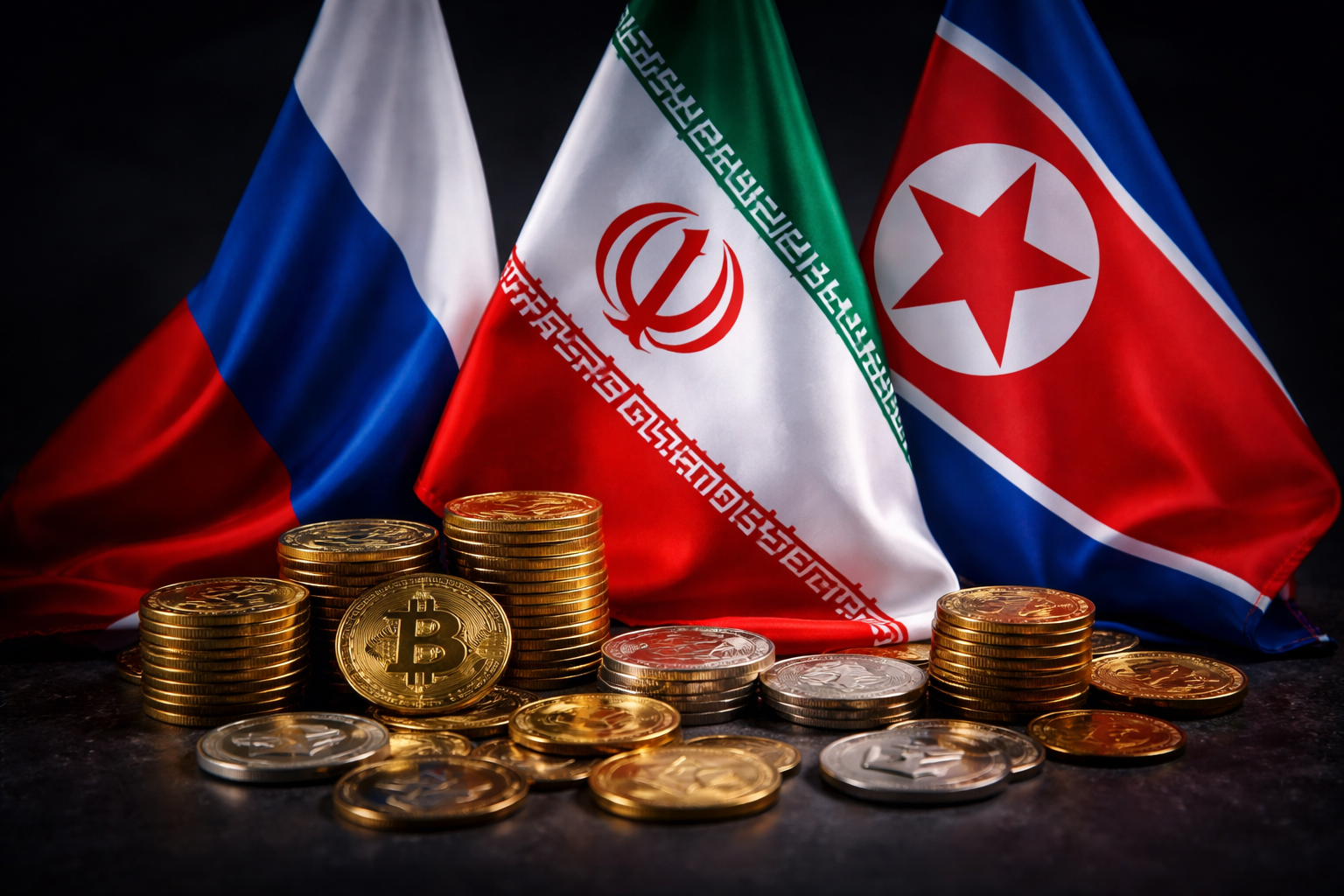
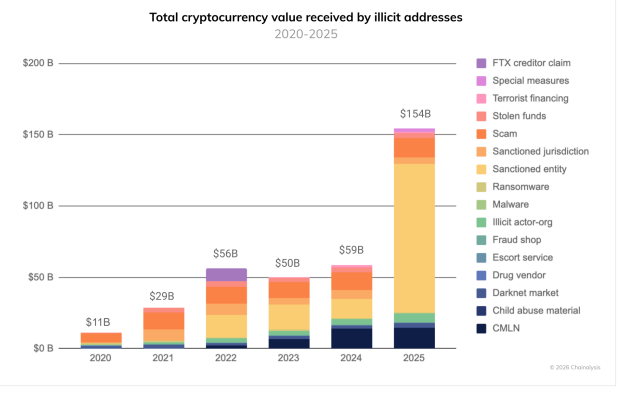
Sanctioned governments increasingly turned to cryptocurrency in 2025 to bypass international financial restrictions, pushing illicit on-chain activity to unprecedented levels. According to new blockchain analysis data from chainalysis, entities linked to sanctioned states received at least $104 billion in crypto during the year. This sharp rise represents nearly eight times the amount recorded in 2024 and helped drive total illicit crypto transaction volume to approximately $154 billion.
The trend highlights how digital assets are becoming part of broader financial strategies used by governments facing global economic pressure. By leveraging decentralized networks and alternative payment rails, sanctioned actors can move funds across borders outside the traditional banking system.
Stablecoins Dominate Illicit Crypto Transaction
Stablecoins accounted for roughly 84% of illicit cryptocurrency transaction volume in 2025. These assets provide liquidity, price stability, and easy transferability, making them attractive tools for cross-border payments and sanctions evasion.
Investigations found that a ruble-pegged token known as A7A5 played a major role in this ecosystem. The digital currency processed more than $93 billion in transactions within less than a year. Analysts say the token became a settlement mechanism for businesses involved in cross-border trade linked to sanctioned markets.
A specialized swapping service designed for the token allowed users to convert it into widely used dollar-pegged stablecoins with minimal identity verification. This conversion bridge has already processed more than $2 billion in transactions, allowing funds to flow into the broader cryptocurrency economy.
Addresses connected to the Islamic Revolutionary Guard Corps handled a significant portion of Iran-related crypto flows by late 2025. Blockchain tracking indicates that more than $3 billion moved through networks linked to regional financing, oil trade, and procurement operations.
North Korea Remains a Major Crypto Theft Actor
North Korean cyber groups continued to rely on hacking to obtain digital assets. In 2025 alone, they reportedly stole over $2 billion in cryptocurrency, including approximately $1.5 billion from a major exchange breach—one of the largest digital asset thefts ever recorded.
Structural Shift in Global Crypto Crime
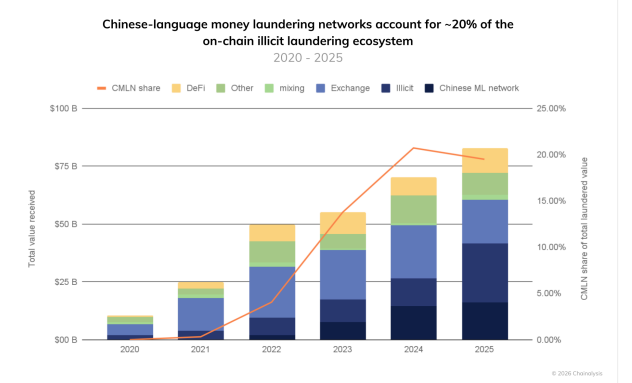
The data points to a major transformation in how illicit actors operate in the crypto ecosystem. Instead of relying mainly on anonymous tokens, sanctioned entities now favor liquid stablecoins that can move quickly between exchanges and wallets.
As regulatory scrutiny increases worldwide, analysts expect governments and financial watchdogs to intensify efforts to monitor blockchain networks and close the loopholes that enable large-scale sanctions evasion.
Disclaimer
This content is for informational purposes only and does not constitute financial, investment, or legal advice. Cryptocurrency trading involves risk and may result in financial loss.