

A Slovak developer has reignited debate over data restrictions on the Bitcoin network after embedding a 66-kilobyte TIFF image directly into the blockchain through a single contiguous transaction.
Martin Habovstiak, maintainer of a Rust-based Bitcoin library, published a proof-of-concept showing that large files can be encoded without using OP_RETURN, Taproot, or OP_IF instructions. The transaction, verifiable onchain, can be decoded from raw hexadecimal data into a standard TIFF image file.
Habovstiak announced the project on X on Thursday;
BIP-110 Proposal Faces Technical Challenge
The demonstration challenges core arguments behind BIP-110, a temporary soft fork proposal designed to limit arbitrary data storage. Originally introduced as BIP-444, the proposal would cap OP_RETURN outputs at 83 bytes and restrict data pushes to 256 bytes. Supporters argue such measures reduce spam and legal risk for node operators.
Habovštiak contends his transaction bypasses the scripting vectors targeted by the proposal, suggesting that similar data storage could persist even if the soft fork were adopted.
Bitcoin Core vs Bitcoin Knots Debate Intensifies
The dispute reflects broader tensions between contributors aligned with Bitcoin Core and those supporting Bitcoin Knots. Proponents of tighter controls, including Knots maintainer Luke Dashjr, argue that inscriptions and large data transactions divert Bitcoin from its monetary purpose.
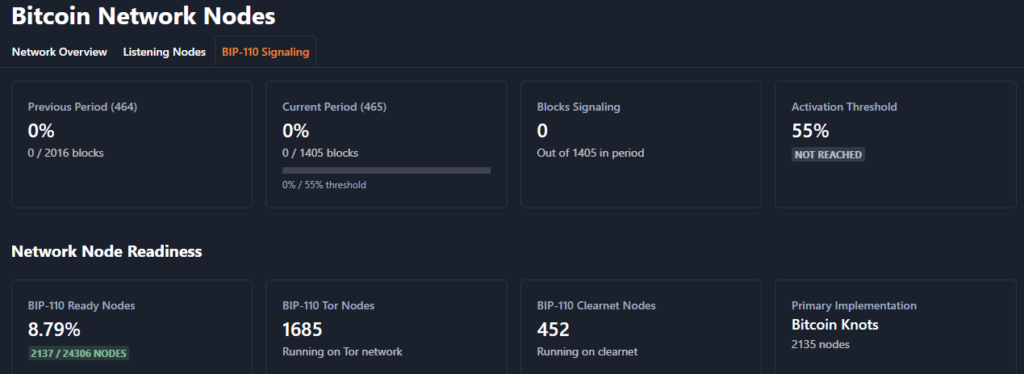
Approximately 9% of publicly reachable nodes currently signal readiness for BIP-110, according to network monitoring data. Habovštiak has stated the experiment was a one-time effort intended to address what he described as technical misconceptions rather than encourage further blockchain data embedding.
Disclaimer
This content is for informational purposes only and does not constitute financial, investment, or legal advice. Cryptocurrency trading involves risk and may result in financial loss.